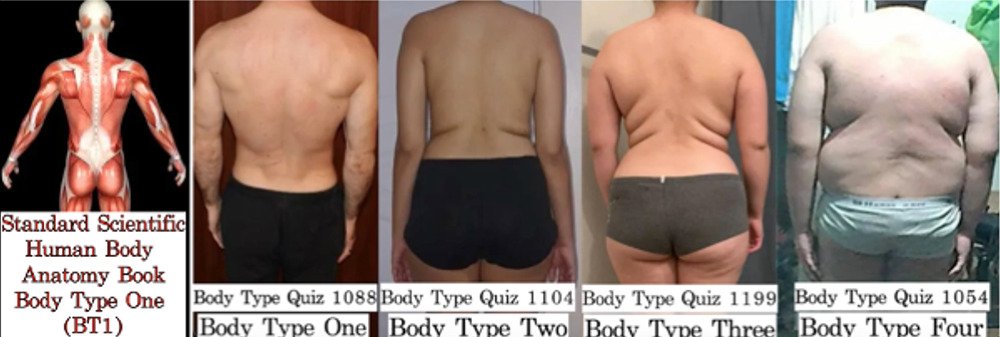
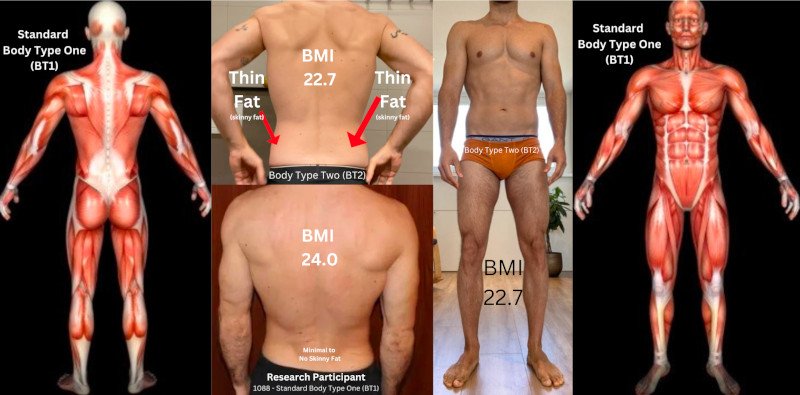
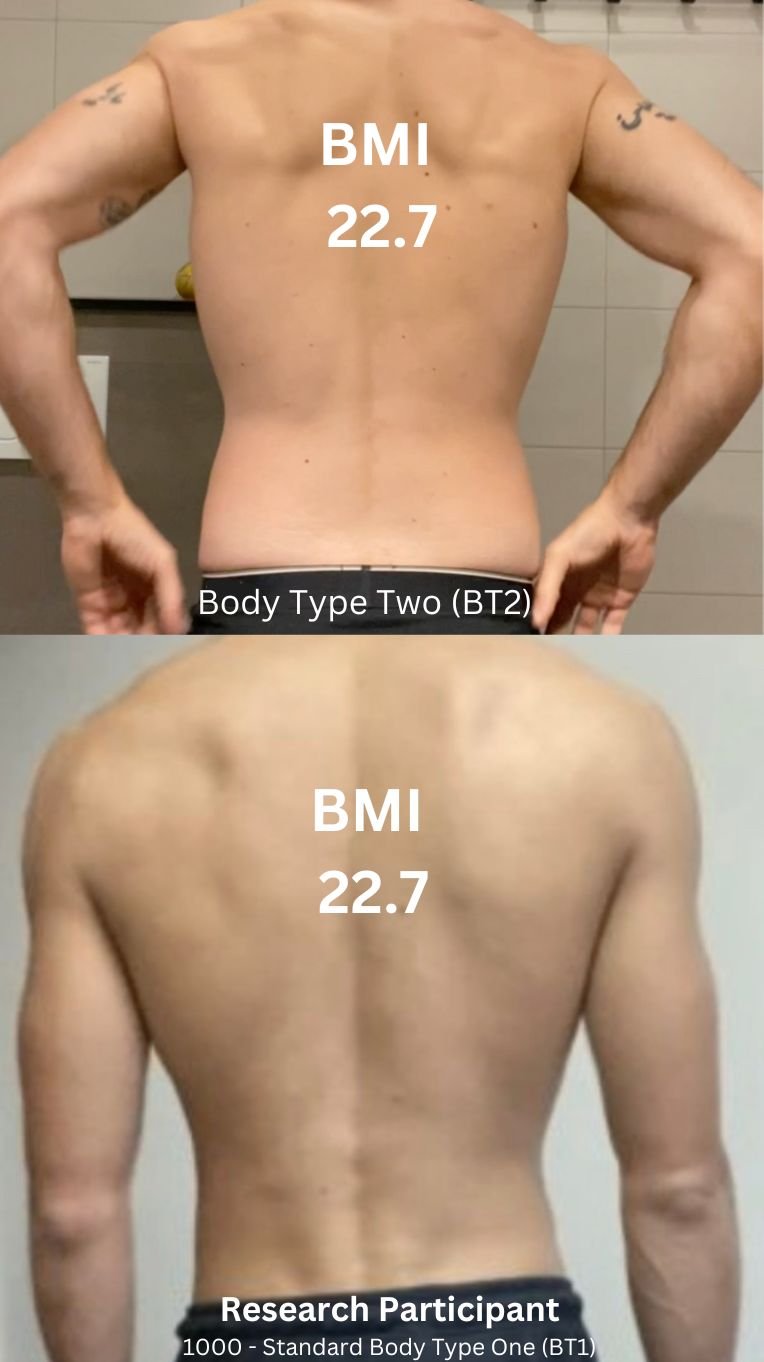
In the image above, notice how the Body Type One/BT1 (BMI 24.0) looks like the Standard Body Type One with all 600+ muscles developed, yet the obvious lack of muscle on the Body Type Two/BT2 (BMI 23.3) around no less than lumbar 1, Body Type Three/BT3 (BMII 30.9) around no less than thoracic 5-12, and Body Type Four/BT4 (BMI 29.8) pretty much everywhere. The Four Body Types you see in the above image are real, actual people who took the Scientific Body Type Quiz.
Due to genetics, skinny fat (lack of genetic muscle) exists in place of where muscle tissue should, but is not — our MRI Study is working on proving this. The more skinny fat (lack of genetic muscle) you have, the slower your metabolism and the more it increases the probability of being overweight or obese. Science recognizes that one pound of muscle burns 6 calories per day, but 1 pound of regular white/yellow fat (common adipose tissue) and/or skinny fat (thin fat, cellulite) burns only 2-3 calories daily.
Vertebrae Fully Developed along with Posture (Spinal Extension)
Vertebrae Mostly Developed along with Posture (Spinal Extension)
Vertebrae Partially Developed along with Posture (Spinal Extension)
Vertebrae Mostly to Fully Undeveloped along with Posture (Spinal Extension)
Number of Vertebrae -- 7 Cervical, 12 Thoracic, 5 Lumbar, 1 Sacrum, 1 Coccyx -- Fully Developed (out of 26 Vertebrae in terms of 24 Moveable, 2 Fixed)
All 26 Vertebrae Fully Developed (Genetics), relative to the 24 Moveable & Two Fixed Bones & related 600+ Muscles (0 Vertebrae Underdeveloped/Undeveloped)
18 to 25 Vertebrae Fully Developed (Genetics), relative to the 24 Moveable & Two Fixed Bones & related Muscles (1-8 Vertebrae Underdeveloped/Undeveloped)
17 to 09 Vertebrae Fully Developed (Genetics), relative to the 24 Moveable & Two Fixed Bones & related Muscles (9-17 Vertebrae Underdeveloped/Undeveloped),
08 to 0 Vertebrae Fully Developed (Genetics), relative to the 24 Moveable & Two Fixed Bones & related Muscles (18-26 Vertebrae Underdeveloped/Undeveloped)
Muscle Development*
Muscles Fully Developed
Muscles Developed
Muscles Partially Developed
Muscles Mostly Undeveloped
Skinny Fat Proclivity* (the more skinny fat a person has, the more prone they are to being overweight or obese)
Minimal To No Skinny Fat (Lack of Genetic Muscle)
Slight to Moderate Skinny Fat (Lack of Genetic Muscle)
Moderate High to Severe Skinny Fat (Lack of Genetic Muscle)
Very Severe to Extreme Skinny Fat (Lack of Genetic Muscle)
The Four (4) Body Types - Body Type Science Theory Data Summary*
A Body Type One (BT1) is the most balanced relative to all of The Four Body Type. A Body Type One has a high probability of being symmetrical. A BT1 usually requires much less maintenance in terms of Diet, Exercise, and Lifestyle to manage and stay healthy. Avoiding obesity is very likely. Skinny fat (normal weight obesity, cellulite, thin fat, loose skin, saggy skin, crepey skin) is unlikely. A Body Type One has fully developed muscles and likely is well defined, or easy to attain full definition with minimal effort.
A Body Type Two (BT2), well taken care of, can look almost identical to a BT1. Although a Body Type Two has tendencies to be less symmetrical. A BT2 usually requires more maintenance than a BT1 in terms of Diet, Exercise, and Lifestyle to manage and stay healthy. Obesity tendencies increase relative to a BT1. At least some skinny fat (normal weight obesity, cellulite, thin fat, loose skin, saggy skin, crepey skin) is likely. A BT2 has mostly developed muscles and likely less definition than a BT1. Fully defined status is possible by building muscle mass. However, keep in mind that using weight lifting/free-weights, machines, or other such conventional repetitive activity means once the repetition stops, the added muscle mass usually is readily lost.
A Body Type Three (BT3) Body is usually much less symmetrical and requires much greater effort in terms of Diet, Exercise and Lifestyle to manage and stay healthy. For a Body Type Three, avoiding obesity can be very difficult, as even when skinny, normal weight obesity is common. Skinny fat (normal weight obesity, cellulite, thin fat, loose skin, saggy skin, crepey skin), in general, is very likely. A BT3 has much less developed muscles and has a much harder time achieving defined status of any degree. Fully defined status is likely not really possible with conventional muscles mass building effort. Keep in mind that using weightlifting/free-weights, machines, or other such conventional repetitive activity means once the repetition stops, the added muscle mass usually is readily lost.
A Body Type Four (BT4) Body is the least balanced of all body types and typically not symmetrical, especially as it ages. A Body Type Four likely requires monumental effort in terms of Diet, Exercise and Lifestyle to successfully manage and stay healthy. Avoiding obesity entirely is very likely impossible, as even when skinny, normal weight obesity is very common. Skinny fat (normal weight obesity, cellulite, thin fat, loose skin, saggy skin, crepey skin), in general, is extremely likely. A BT4 has mostly to fully underdeveloped muscles. Fully defined status is very likely impossible with conventional muscle mass building effort. Keep in mind that using weigh training/free-weights, machines, or other such conventional repetitive activity means once the repetition stops, the added muscle mass usually is readily lost.
*The Four Body Types (Genetic Scientific Body Type)/Body Type Science Theory Research Data to Date
This website uses cookies to improve your experience. We'll assume you're ok with this, but you can learn more...Got ItRead More
Cookies Policy
Privacy Overview
This website uses cookies to improve your experience while you navigate through the website. Out of these, the cookies that are categorized as necessary are stored on your browser as they are essential for the working of basic functionalities of the website. We also use third-party cookies that help us analyze and understand how you use this website. These cookies will be stored in your browser only with your consent. You also have the option to opt-out of these cookies. But opting out of some of these cookies may affect your browsing experience.
Necessary cookies are absolutely essential for the website to function properly. This category only includes cookies that ensures basic functionalities and security features of the website. These cookies do not store any personal information.
Any cookies that may not be particularly necessary for the website to function and is used specifically to collect user personal data via analytics, ads, other embedded contents are termed as non-necessary cookies. It is mandatory to procure user consent prior to running these cookies on your website.