
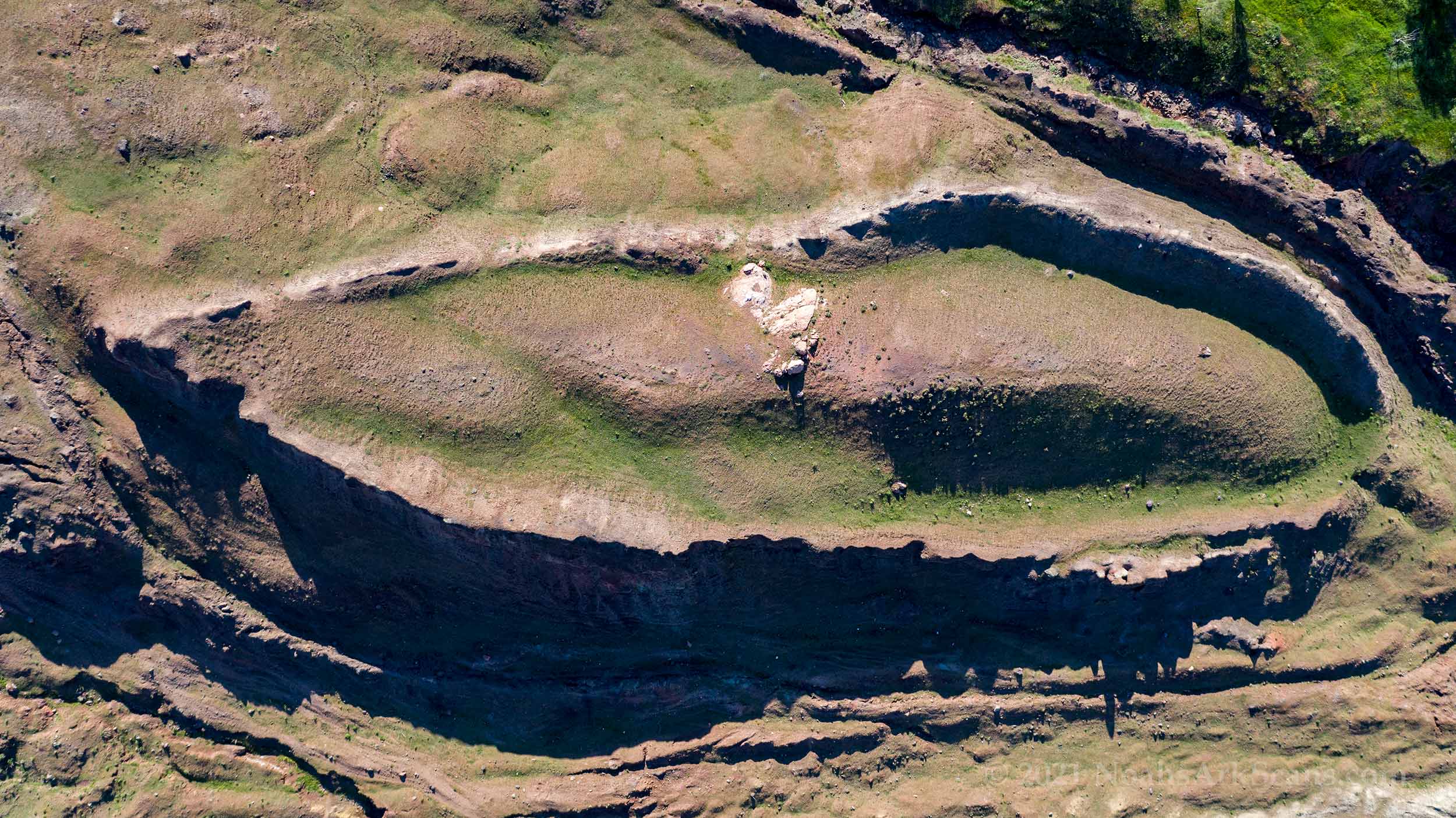
“In 1959, Captain İlhan Durupınar discovered this 157-meter-long (515 feet) boat-shaped formation in aerial reconnaissance photographs of eastern Turkey near Mount Ararat. The structure perfectly matches the biblical description of Noah’s Ark found in Genesis 6. Located in the mountains of Ararat, the site has been referenced in both Genesis 8:4 and the Qur’an 11:44, with the local name “Al-Judi” preserved through generations.
Researcher Ron Wyatt brought widespread attention to the site in the late 1970s through the 1990s, conducting hands-on investigations that measured the formation at approximately Royal Ancient Egyptian 300 cubits in length. In 1987 and 1988, Dr. John Baumgardner and Dr. Salih Bayraktutan radared the site and attempted to drill four core holes, though only three reached significant depths but the wrong type of core drilling machine was used and the data was washed away by the water used to cool the bit. This limited sampling left much of the 515-foot formation uncharacterized.”
Noah’s Ark Project Details
“In 2026, a full geological and archaeological research project was initiated at the Noah’s Ark formation in the Doğubayazıt District of Ağrı Province, Türkiye. The project is directed by Prof. Dr. Cenker Atila of the Department of Archaeology at Sivas Cumhuriyet University, and is carried out in cooperation with Noah’s Ark Scans.The project has received official approval from the Republic of Türkiye. Under this authorization, a series of geological and archaeological investigations will be conducted at the site in accordance with the approved research plan — a milestone after decades of patient, non-invasive study.”
“The Noah’s Ark Scans team, working in collaboration with Turkish scientists and others, is conducting the most comprehensive geological and geophysical survey and later archaeological research of the Durupinar site to date. Using core drilling, GPR, ERT, LiDAR, other geophysical survey technologies, and chemical analysis, the team is building a complete subsurface map of the formation. This year’s 2026 Turkish Government’s Scientific Project marks a major milestone. What about excavations? Excavations can only happen after geophysical surveys are finished and core drilling is done — a methodical approach that uses core drilling (3-6 inch diameter holes) before any possible excavation is done by professional archaeologists to determine subsurface layers. Each expedition brings new data, new questions, and new insights.”
Hypothesis
If the Durupınar site is proven to be a man-made vessel and securely dated to around 10,800 BC, it would completely upend our understanding of history and align perfectly with the Younger Dryas Impact hypothesis. This would place the Ark narrative right before the construction of Göbekli Tepe (located in nearby southern Turkey, dating to ~9600 BC). In this hypothetical timeline, the survivors of the Younger Dryas cataclysm would have brought advanced agricultural and architectural knowledge out of the mountains of Ararat, directly explaining the sudden, sophisticated birth of stone architecture and farming in the Fertile Crescent.
This would mean that the biblical timeline of ~2500 BC is not the date of the event, but rather the date when the survivors’ descendants finally stabilized, invented writing, and wrote down an ancient oral history. By the time the Sumerians wrote the Epic of Gilgamesh or the Hebrews wrote Genesis, the event was already 8,000 years in the past. The original story, likely oral, would have survived as a generational memory of an advanced, pre-Ice Age civilization that was wiped out by a sky-born disaster.
For this hypothesis to move from a fascinating thought experiment to reality, the 2026 Turkish Government Scientific Project and the Noah’s Ark Scans team have to clear a very high scientific bar. The laboratory results from their recent core drilling would need to show:
- Anthropogenic Material: Proof that the “dense subsurface layer” that broke their drill bit is man-made metal, structural timber, or processed ballast, rather than natural ophiolite rock. In fact, 12,800 years is long enough for wood to petrify—under the right conditions.
- Organic Dating: C-14 radiocarbon dating of organic matter embedded inside the structure that consistently returns a date of ~12,800 years before present (BP). If the conditions for petrification weren’t perfect, raw wood exposed to regular soil moisture and bacteria would be 100% degraded after 12,800 years, leaving behind incredibly distinct chemical and structural footprints that cannot be erased by time:
- The Organic Carbon Spike: When a massive volume of timber decays, it alters the soil chemistry forever. This aligns with why the project’s scientists reported that soil samples from inside the boat-shaped formation contain nearly three times the organic matter and significantly more carbon than the soil directly outside it.
- The Potassium Signature: Wood ash and decomposing timber leave behind highly elevated levels of potassium. The preliminary testing from the Turkish laboratories showed a 38% increase in potassium inside the formation compared to the natural surrounding mudflows.
- The Phosphorus “Ghost”: If this was a survival vessel packed with animals and humans, their biological waste, food scraps, and bones would leave behind high levels of phosphorus. Interestingly, the 2024–2026 soil sweeps noted a lack of a phosphorus spike. This heavily suggests that if it was an artifact, it represents a structure that decayed rapidly without long-term human habitation—fitting the profile of a temporary refuge rather than an ancient city or a natural farm.
- The Ultimate Test – Microscopic Analysis: Because the wood would be fully decayed or structurally transformed, the team is not looking for regular tree bark. Instead, university labs in Turkey are using Scanning Electron Microscopy (SEM) on the core samples this winter. They are looking for “biogenic ghosts”—microscopic, mineralized casts of cellular walls, sap channels, or wood fiber architecture embedded in the dirt. If the dirt holds the microscopic skeletal shape of gopher wood cells, the theory moves from a wild hypothesis to a factual reality.