Scientific Body Type Quiz/Test, What is My Body Type? – The Four Body Types


TAKE THE SCIENTIFIC BODY TYPE QUIZ (WOMEN & MEN) NOW

Review Body Type Quiz (Woman & Man) Science-Based Test Results


Body Type Science Video – What Is My Body Type?
YouTube player


What is My Body Type Quiz/Test - The Four Body Types, Fellow One ResearchBody Type Science asks, “what is my body type?” Fellow One Research’s The Four Body Types Scientific Weight Loss Body Type Quiz/Test (women/females and males/men) answers that question by calculating a scientifically diverse array of carefully chosen science-based variables. Data points like diet, exercise, lifestyle, metabolism/metabolic rate (BMR), Body Mass Index (BMI), and genetics/DNA including vertebrae, muscles/mass, fat, and skinny fat to help you better understand how to know what my body type is.

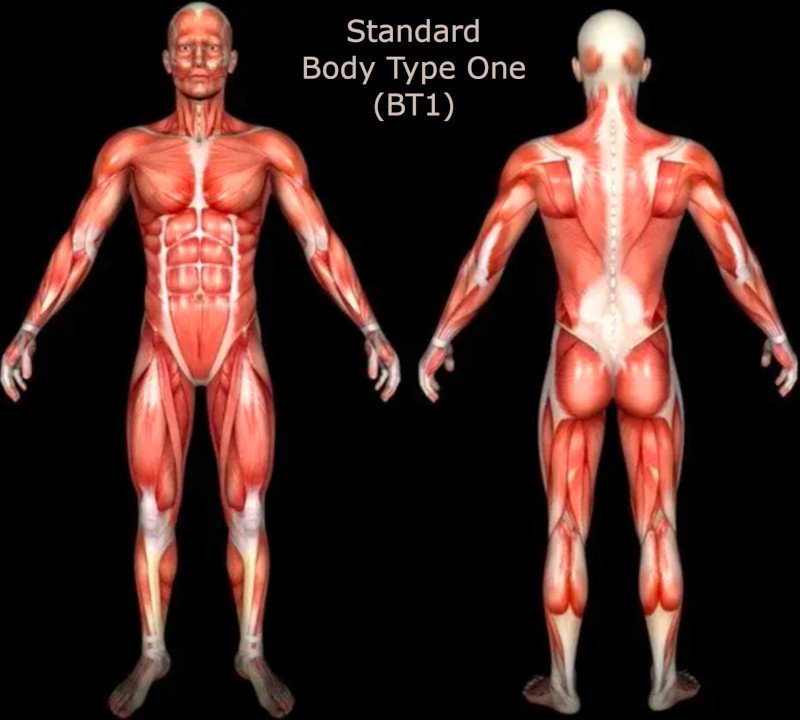
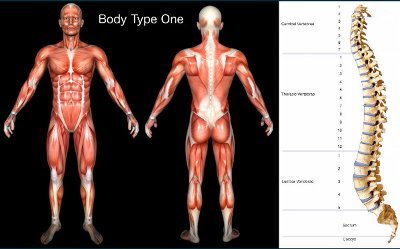
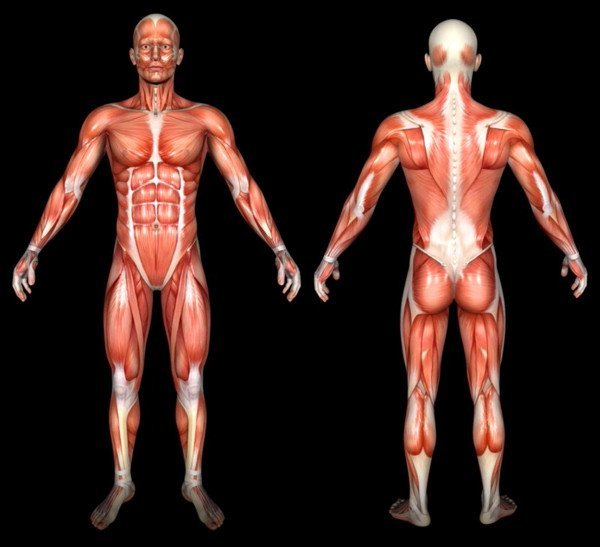
Visit any mainstream doctor and they will have the same general Standard Scientific Human Body Anatomy Book Body Type One (BT1) image in their office showing what the standard (“normal”) human body looks like fully developed, including vertebrae (posture) and muscles/mass.

What is My Body Type? Fellow One Research Body Type Quiz/Test Calculator - The Four (4) Body Types
Standard Scientific Human Body Anatomy Book Body Type One (BT1)

That human body image is considered by mainstream doctors and scientists to be the model of perfection. It is the standard that you and all human beings are held to when it comes to overall health. That perfect standard that a minority — roughly 30% of the entire human population — actually meet and are.

Standard Scientific Human Body Anatomy Book Body Type One (BT1) – What Is My Body Type?

Are you a Standard Scientific Human Body Anatomy Book Body Type One (BT1) just like mainstream science says you and all human beings are if you are safely within your medically/scientifically safe BMI weight range (unless a licensed medical doctor has diagnosed you with a specific malformation, underdevelopment, abnormality, or the like)? Or do you/are you dealing with skinny fat (thin fat, cellulite, crepey skin, loose skin, saggy skin, normal weight obesity), even though you are well within your scientifically/medically safe BMI weight range?

If so, why — what is your doctor’s explanation for things? Do they continue to blame it on consuming too many calories, even though you are within your safe BMI? How do they explain where the muscle is that has been replaced by skinny fat? 

It is a Genetic Fact that Any Part of the Human Body can be Undeveloped or Underdeveloped, to Whatever Degree

*If it is true that any part of the human body can be genetically underdeveloped, then it is a fact that muscles/mass & vertebrae/posture can be underdeveloped or undeveloped, to whatever degree.

What is My Body Type Quiz - Scientific Body Type Quiz/Test*If it is true that muscles/mass can be genetically underdeveloped, then skinny fat, especially cellulite and normal weight obesity, is a valid scientific explanation for what exists in place of that genetically underdeveloped/missing muscles/mass.

*If it is true that, anatomically, every vertebra houses a specific set of muscle(s), then it is true that those specific muscle(s) directly influence the specific vertebra.

*If it is true that vertebrae directly affect posture, then it is true that muscles/mass directly influences posture.

*If BMI, BMR, & the Standard Scientific Human Body Anatomy Book Body Type One are the accurate gold standards in determining human health, then how do mainstream scientists and medical doctors explain so many different body types and skinny fat including normal weight obesity, no less, relative to countless people worldwide who are within safe BMI yet do not look like the Standard Scientific Human Body Anatomy Book Body Type One no matter how diligent and healthy they are with their daily diet, exercise, and lifestyle?


What Is My Body – Scientific Weight Loss Body Type Quiz/Test (Woman/Women & Male/Men)

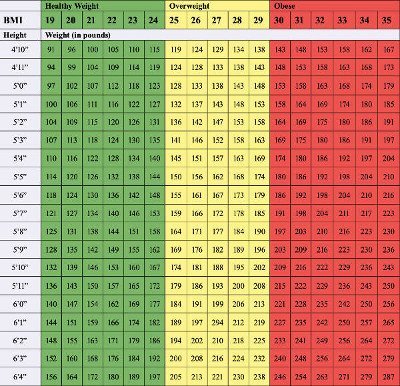
Body Type Science, What is My Body Type Quiz - Body Mass Index (BMI) Weight Scale
Body Mass Index (BMI) Weight Range Scale

When accurately completed, the scientific Body Type Quiz/Test clarifies how do I know what my body type is by identifying which of The Four Body Types you are. Your results are compared to the Standard Scientific Human Body Anatomy Book Body Type One (BT1) relative to your specific human body shape in terms of vertebrae (posture) and muscles/muscle mass development, no less. Your data-driven body type test results determine BMI as well as science-based diet, exercise, and lifestyle health scores.

Metabolism scores are measured in terms of slow or normal (fast is not possible at this time) and decreased, steady, or increased metabolic rate. Scores are calculated using the Standard Mifflin St Jeor equation BMR (basal metabolic rate) and Harris-Benedict equation for activity . The Adjusted Mifflin St Jeor BMR is reckoned directly relative to skinny fat.


The Three Body Types: Endomorph, Ectomorph, Mesomorph & Hormone Body Types – What is My Real Body Type?

Body Type Quiz/Test Calculator Free - The Three Body Types, Endomorph, Ectomorph, Mesomorph
Somatotypes, Debunked and Discredited in the 1950s (70 years ago!)

For years the debate has raged about what is my body type? Some say how do I know what my body type is should be answered using the three body types or hormone body types. But well-founded, cutting-edge new science is afoot, shining a light on those unscientific and baseless body types while offering new grounded, scientific methodology in the form of The Four Body Types.

Most people have heard of the three body types: endomorph, ectomorph, and mesomorph. Just as most people learn quickly that there is no real rhyme or reason as to why they might be one of those three body types. Why? Because those scientifically unfounded body types are based solely on arbitrary shapes like an apple or a pear and subjective observation alone. All one has to do is take any of the useless free three body types quiz options online to verify how baseless they are from a common-sense point of view, let alone scientifically.

The Hormone Body Types

Hormone body types are no better. Yes, it is a fact that many different hormones affect male and female human bodies in many different ways. This includes obesity and the weight loss and gain management and maintenance roller coaster ride.

But, what about all the people in the world who have not been diagnosed with any hormone imbalances yet their body still does not look like the Standard Scientific Human Body Anatomy Book Body Type One (BT1) when within safe BMI? If hormones are not the reason why, then what is the scientific/medical explanation? The Four Body Types’ Body Type Science clearly explains why. 

Review Body Type Quiz Participants Scientific Test Results

TAKE THE SCIENCE-BASED BODY TYPE QUIZ NOW

Fellow One Research’s Scientific Body Type Quiz/Test Calculator – The Four Body Types & How Do I Know What My Body Type Is?

The Four Body Types’ Body Type Science research focuses on the structure and development, or lack thereof, of the human body. More to the point, the vertebrae and spinal column (posture) in direct relation to the level of development of muscles and muscle mass. Any scientifically accepted mainstream anatomy book has a universally acknowledged and approved view of a fully and properly developed human body; known as a Body Type One (BT1), seen here: Body Type One (BT1) - Body Type Test Calculator, What is My Body Type? A BT1, also known as an athletic body type, in terms of genetics/DNA has all 200-plus bones along with 33 spinal vertebrae (relative to the 24 moveable & two fixed bones) fully developed and extended (proper posture). As well, a BT1 has all 640 or so muscles and muscle mass, including tendons, ligaments, and the like, all fully and properly developed. This is why, by definition, a BT1 has zero (0) undeveloped vertebrae.
Along with those important variables, diet (food & drink), exercise (cardio & resistance), and lifestyle (sleep, stress, etc.) also significantly, directly influence body type. Moreover, metabolism and metabolic rate (Standard Mifflin St Jeor formula BMR & Harris-Benedict formula), BMI, fat proclivity (overweight/obese), skinny fat, and historical weight loss and gain (childhood & adult obesity) are given fair consideration to achieve as accurate a body type test result as possible. Keeping in mind that this is a relatively basic overall scientific Body Type Quiz evaluation and how honest you are influences the accuracy of the aggregate end results.

General Breakdown – Body Type One, Two, Three, and Four

Directly relative to genetics/DNA, 26 vertebrae (7 cervical, 12 thoracic, 5 lumbar, 1 sacrum, 1 coccyx):
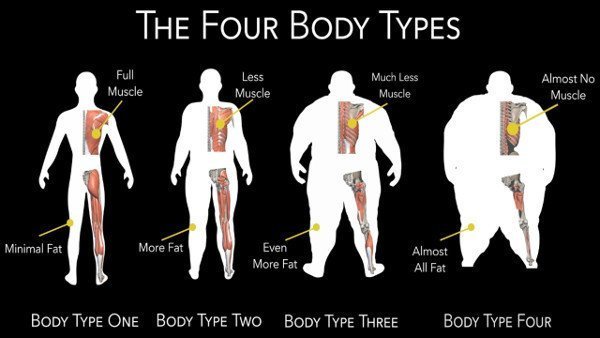
Fellow One Research, Body Type Science - The Four Body Types, Body Type Quiz The Body Types you see in the above image are generalized. A Body Type Two (BT2) can look nearly identical to a Body Type One (BT1), a Body Type Three (BT3) like a BT2, Body Type Four (BT4) like a BT3, etc. – especially the younger one is.

Body Type One (BT1)All 26 Vertebrae Fully Developed (Posture & Muscles/Muscle Mass), relative to the 24 Moveable & Two Fixed Bones (0 Vertebrae Underdeveloped)

Body Type Two (BT2) – Between 25 and 18 Vertebrae Fully Developed (Posture & Muscles/Muscle Mass), relative to the 24 Moveable & Two Fixed Bones (1-8 Vertebrae Underdeveloped)

Body Type Three (BT3) – Between 17 and 09 Vertebrae Fully Developed (Posture & Muscles/Muscle Mass), relative to the 24 Moveable & Two Fixed Bones (9-17 Vertebrae Underdeveloped)

Body Type Four (BT4) – Between 08 to 0 Vertebrae Fully Developed (Posture & Muscles/Muscle Mass), relative to the 24 Moveable & Two Fixed Bones (18-26 Vertebrae Underdeveloped)

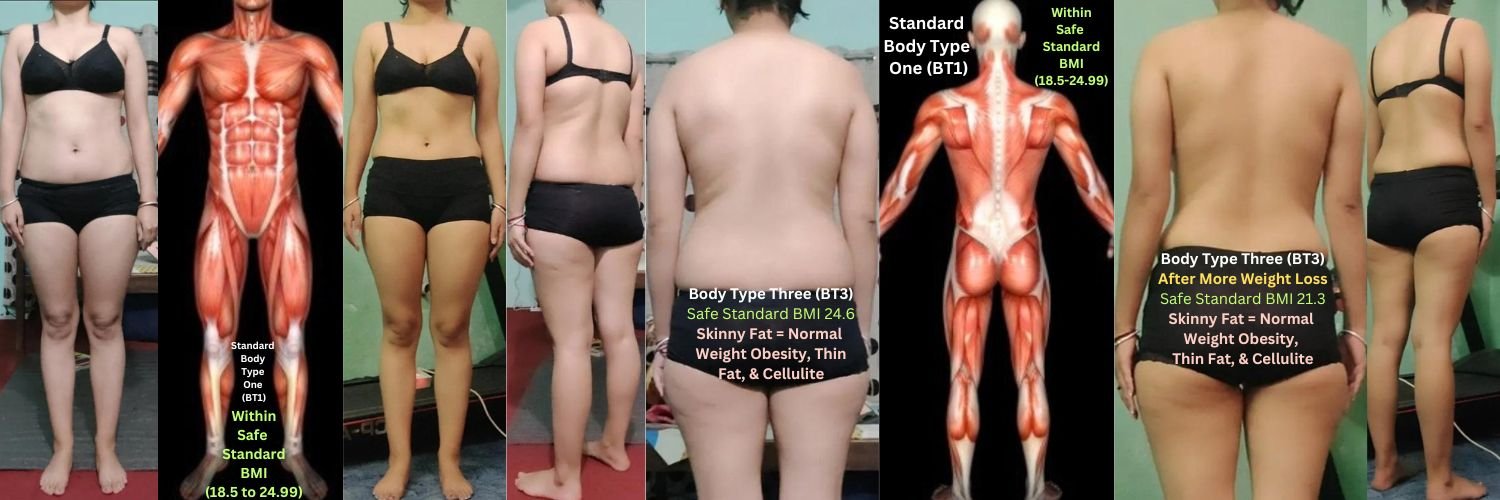
The Four Body Types - Scientific Body Type Quiz Examples, BT1, BT2, BT3, BT4
Note how the Body Type One (BT1) looks identical to the Standard Scientific Human Body Anatomy Book Body Type One (BT1) (see above) with all muscles and muscle mass fully developed, yet the obvious lack of muscles/muscle mass on the Body Type (BT2) around no less than lumbar 1, Body Type Three (BT3) around no less than thoracic 5-12, and Body Type Four (BT4) pretty much everywhere.

Take the Fellow One Research, The Four Body Types Body Type Quiz/Test Calculator (Male/Man & Female/Woman) – What Is My Body Type/How How Do I Know What My Body Type Is

Scientific Weight Loss Video

Old Weight Loss Science vs New Weight Loss Science


Browse Celebrities


Browse: Adult Obesity, All Posts, Athletic Body Type, Awakening, Body Mass Index (BMI), Body Type Four (BT4), Body Type One (BT1), Body Type Quiz (Test) - The Four Body Types, Body Type Science, Body Type Science Research Data, Body Type Three (BT3), Body Type Two (BT2), Celebrity Body Types, Female & Male, Cellulite, Childhood Obesity, Diet, Exercise, Fat, Featured Article, Fellow One Research, Female, Gnostic, Gnosticism, Gut Feeling, Gut-Brain Axis, Health, Healthcare, How to Eat Right, How to Gain Weight Naturally, How to Gain Weight Safely, How to Live a Healthy Life, How to Live Healthy, How to Lose Weight, How to Lose Weight Naturally, How To Lose Weight Safely, How to Naturally Lose Weight, How to Safely Lose Weight, IT Factor, Lead Posts, Learn About Body Type Four, Learn About Body Type One, Learn About Body Type Three, Learn About Body Type Two, Lifestyle, Male, Man, Metabolism, Muscle Mass, Muscles, Normal Weight Obesity, Posture, Science, Scientific Body Type Quiz, Scientific Research, Scientific Weight Loss & Comments, Scientist, Self-Help, Self-Improvement, Skinny Fat, Soul, Soul Energy, Soul Searching, Spinal Extension, Spiritual, Spiritual Science, Spiritual Scientist, Star Power, The Four Body Types, Thin Fat, Trending News, Vertebrae, Weight Gain, Weight Loss, Weight Management, What Is My Body Type, Woman

Different Male Body Types – What Is My Body Type According to Science?

There are, indeed, different male body types. However, it is an undisputed scientific fact that the endomorph, ectomorph, and mesomorph somatotype body types were fully discredited in the 1950s and are unscientific, baseless, arbitrary, subjective, and fully debunked body types. They are nonsense.

The same is true for hormone body types (adrenal, thyroid, liver, ovary), Kibbe, triangle, 10 body types, etc. Disagree? Prove us wrong by posting credible links in the comment section below to the science that backs up any of those body types.


Understanding Current Scientific Body Type Standards


In fact, the current mainstream science and medical doctor’s body type standards for both different male body types as well as female — the actual standards that your doctor uses at your regular checkup to determine whether you are normal and healthy — are:

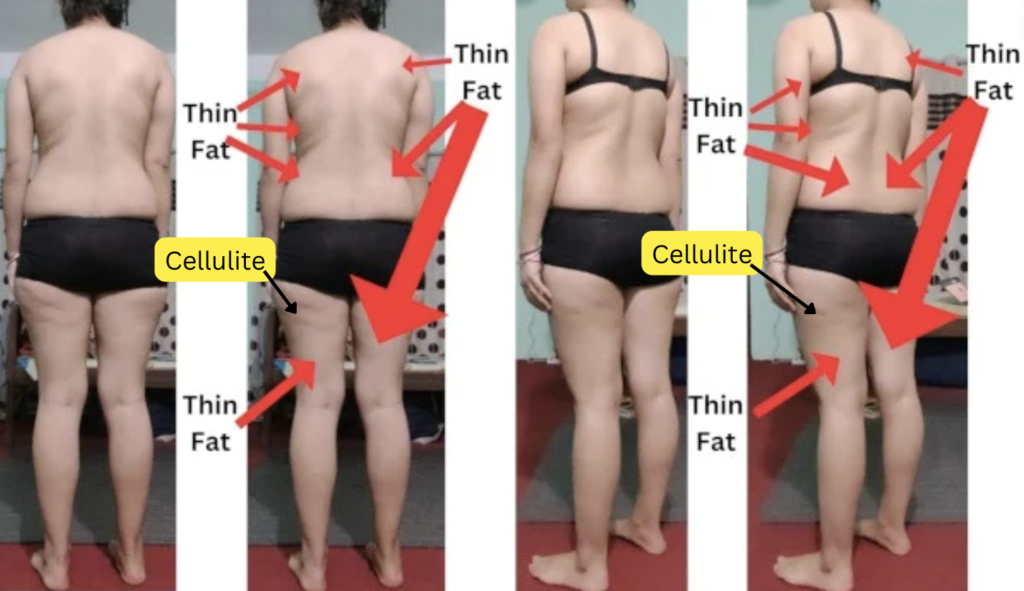
  1. Standard #1: The Standard Scientific Human Body Anatomy Book Body Type One (BT1) found in any mainstream scientific human body anatomy book, with genetically fully developed muscles/muscle mass, no less. This scientific standard is not accurate because, genetically, it does not account for the fact that any part of the human body can be underdeveloped or undeveloped, to whatever degree (AKA body dysmorphic disorder/body dysmorphia). This includes muscles/muscle mass and vertebrae/posture. If you are within safe BMI yet have skinny fat (cellulite, thin fat, loose skin, saggy skin, crepey skin, and/or normal weight obesity) where there should be muscles/mass, this is most likely due to genetics.

The Standard Scientific Human Body Anatomy Book Body Type One (BT1)

  • Standard #2: Body Mass Index (BMI), calculated directly relative to the BT1. This scientific standard is not accurate because, genetically, skinny fat is very real. If you are within safe BMI but have skinny fat in place of where there should be muscle on your body, then where is the muscle/muscle mass that mainstream science and doctors say is already on every BT1 once within safe BMI? The truth is, BMI does not include in its calculation the real-life variable that is skinny fat. Moreover, it is possible to have excess muscle mass on your body (think Dwayne Johnson “The Rock”) that will put you into the overweight or obese columns of your BMI weight scale, but because you do not have excess/too much fat on your body you are not overweight or obese. BMI - Different Male Body Types
  • Standard #3: Basal Metabolic Rate (BMR) which is the number of calories per day your specific body needs for basic functioning, calculated directly relative to the BT1 and BMI. This scientific standard is not accurate because, metabolically, the scientifically calculated standard Mifflin St Jeor equation and Harris-Benedict equation for activity do not take into account skinny fat. Skinny fat directly, negatively affects your metabolism, no less, because one pound of muscle mass burns six (6) calories per day, but one pound of skinny fat and/or fat burns only two (2) to three (3) calories. The more skinny fat or fat that you have on your body, the more negatively your metabolism is affected, the less accurate your BMR calculations are, and thus the fewer calories your body actually needs daily. 

For a body type to be a real, accurate scientific standard it has to apply to all human bodies equally. Diet, exercise, and lifestyle also matter. Understanding your real scientific body type is key to successful scientific weight management as well as weight loss or gain.

The Four Body Types, Body Type Science Standards – Different Male Body Types, What Is My Body Type?

Fellow One Research’s The Four Body Types are the only real, accurate genetic scientific body type standards in existence. They do apply to all human bodies equally, thus helping you to understand why there are different male body types and different female body types. We have the scientific data to back it up. 


Relative to the 26 Vertebrae (Genetics/DNA), including 7 Cervical, 12 Thoracic, 5 Lumbar, 1 Sacrum, and 1 Coccyx:

Body Type One (BT1)– All 26 Vertebrae (24 Moveable & Two Fixed Bones) Fully Developed, 0 Vertebrae/Posture and Muscles/Muscle Mass Underdeveloped, Minimal Skinny Fat & Low Probability of Obesity (Genetics)

Body Type Two (BT2) – Between 25 and 18 Vertebrae (24 Moveable & Two Fixed Bones) Fully Developed, 1-8 Vertebrae/Posture and Muscles/Muscle Mass Underdeveloped, Some Skinny Fat & Moderate Probability of Obesity (Genetics)

Body Type Three (BT3) – Between 17 and 9 Vertebrae (24 Moveable & Two Fixed Bones) Fully Developed, 9-17 Vertebrae/Posture and Muscles/Muscle Mass Underdeveloped, Skinny Fat is Prevalent & High Probability of Obesity (Genetics)

Body Type Four (BT4) – Between 8 and 0 Vertebrae (24 Moveable & Two Fixed Bones) Fully Developed, 18-26 Vertebrae/Posture and Muscles/Muscle Mass Underdeveloped, Skinny Fat is Severe & Very High Probability of Obesity (Genetics)


The Four Body Types - Comparing BT1, BT2, BT3, and BT4


Browse Celebrities


Browse: All Posts, Body Mass Index (BMI), Body Type Quiz (Test) - The Four Body Types, Body Type Science, Celebrity Body Types, Female & Male, Cellulite, Diet, Exercise, Fat, Featured Article, Fellow One Research, Health, Healthcare, How to Eat Right, How to Gain Weight Naturally, How to Gain Weight Safely, How to Live a Healthy Life, How to Live Healthy, How to Lose Weight, How to Lose Weight Naturally, How To Lose Weight Safely, How to Naturally Lose Weight, How to Safely Lose Weight, How to Successfully Lose Weight, Lead Posts, Learn About Body Type Four, Learn About Body Type One, Learn About Body Type Three, Learn About Body Type Two, Lifestyle, Male, Man, Metabolism, Muscle Mass, Muscles, Normal Weight Obesity, Posture, Science, Scientific Body Type Quiz, Scientific Research, Scientific Weight Loss, Scientist, Self-Help, Self-Improvement, Skinny Fat, Spinal Extension, The Four Body Types, Thin Fat, Vertebrae, Weight Gain, Weight Loss, Weight Management, What Is My Body Type

Different Female Body Types – What Is My Body Type According to Science?

Yes, it is a scientific fact that there are different female body types. That being said, it is also an undisputed scientific fact that the endomorph, ectomorph, and mesomorph somatotype body types were fully discredited 70 years ago and are unscientific, arbitrary, subjective, baseless, and completely debunked body types. They are absolute nonsense.

The same is true for no less than the Kibbe, triangle, 10, and hormone body types (adrenal, thyroid, liver, ovary), etc. You disagree? Ok, then prove us wrong by posting credible links in the comment section below on this page to the science that backs up any of those nonsense body types.


What Are the Current Scientific Body Type Standards?


The current mainstream science and medical doctor’s body type standards for both different female body types as well as male — the actual scientific standards that your doctor uses at your regular checkup to determine whether your body is normal and healthy — are:

  1. Standard #1: The Standard Scientific Human Body Anatomy Book Body Type One (BT1) image approved in any mainstream scientific human body anatomy book, with fully developed genetic muscles/muscle mass, no less. This scientific/genetic standard is not accurate because it does not account for the fact that any part of the human body can be underdeveloped or undeveloped, to whatever degree (AKA body dysmorphia/body dysmorphic disorder). This includes muscles/muscle mass and vertebrae/posture. If you are within your safe BMI weight range yet you have skinny fat (cellulite, thin fat, loose skin, saggy skin, crepey skin, and/or normal weight obesity) on your body where there should be muscles/mass, this is most likely due to your genetics.

The Standard Scientific Human Body Anatomy Book Body Type One (BT1)

  • Standard #2: Body Mass Index (BMI), calculated directly relative to the standard BT1. This scientific, genetic standard is not accurate because it is a fact that skinny fat is real. If you are within your safe BMI yet have skinny fat in place of where there should be muscle on your body, then where is the muscle/muscle mass that mainstream science and doctors say is already on every BT1 once within safe BMI? The truth is, BMI fails to include in its calculation the real-life variable that is skinny fat. Furthermore, it is possible to have excess muscle mass on your body (think Dwayne Johnson “The Rock“) that will put you into the overweight or obese columns of your BMI weight scale, but because you do not have excess/too much fat on your body you are not overweight or obese. BMI - Different Female Body Types
  • Standard #3: Basal Metabolic Rate (BMR) which is the number of calories per day your specific body needs for basic functioning, calculated directly relative to the BT1 and BMI. This scientific standard is not accurate because, metabolically, the scientifically calculated standard Mifflin St Jeor equation and Harris-Benedict equation for activity do not take into account skinny fat. Skinny fat directly, negatively affects your metabolism, no less, because one pound of muscle mass burns six (6) calories per day, but one pound of skinny fat and/or fat burns only two (2) to three (3) calories. The more skinny fat or fat that you have on your body, the more negatively your metabolism is affected, the less accurate your BMR calculations are, and thus the fewer calories your body actually needs daily. 

For a body type to be a real, accurate scientific standard it must apply to all human bodies equally. Diet, exercise, and lifestyle definitely matter. Understanding your real scientific body type is a main key to successful scientific weight management as well as weight loss or gain.

The Four Body Types, Body Type Science Standards – Different Female Body Types, What Is My Body Type?

The Four Body Types are the sole real, accurate genetic scientific body type standards in existence. Whether different female body types or different male body types, our scientific body types apply to all human bodies equally. Fellow One Research has the only scientific data to back it up. 


Relative to the 26 Vertebrae (Genetics/DNA), including 7 Cervical, 12 Thoracic, 5 Lumbar, 1 Sacrum, and 1 Coccyx:

Body Type One (BT1)– All 26 Vertebrae (24 Moveable & Two Fixed Bones) Fully Developed, 0 Vertebrae/Posture & Muscles/Muscle Mass Underdeveloped, Minimal Skinny Fat with Low Proclivity Towards Obesity (Genetics)

Body Type Two (BT2) – Between 25 and 18 Vertebrae (24 Moveable & Two Fixed Bones) Fully Developed, 1-8 Vertebrae/Posture & Muscles/Muscle Mass Underdeveloped, Some Skinny Fat with Moderate Proclivity Towards Obesity (Genetics)

Body Type Three (BT3) – Between 17 and 9 Vertebrae (24 Moveable & Two Fixed Bones) Fully Developed, 9-17 Vertebrae/Posture & Muscles/Muscle Mass Underdeveloped, Skinny Fat is Likely Widespread with High Proclivity Towards Obesity (Genetics)

Body Type Four (BT4) – Between 8 and 0 Vertebrae (24 Moveable & Two Fixed Bones) Fully Developed, 18-26 Vertebrae/Posture & Muscles/Muscle Mass Underdeveloped, Skinny Fat is Likely Severe with Very High Proclivity Towards Obesity (Genetics)


Comparing BT1, BT2, BT3, and BT4 - The Four Body Types


Browse Celebrities


Browse: All Posts, Body Mass Index (BMI), Body Type Quiz (Test) - The Four Body Types, Body Type Science, Celebrity Body Types, Female & Male, Cellulite, Diet, Exercise, Fat, Featured Article, Fellow One Research, Health, Healthcare, How to Eat Right, How to Gain Weight Naturally, How to Gain Weight Safely, How to Live a Healthy Life, How to Live Healthy, How to Lose Weight, How to Lose Weight Naturally, How To Lose Weight Safely, How to Naturally Lose Weight, How to Safely Lose Weight, How to Successfully Lose Weight, Lead Posts, Learn About Body Type Four, Learn About Body Type One, Learn About Body Type Three, Learn About Body Type Two, Lifestyle, Male, Man, Metabolism, Muscle Mass, Muscles, Normal Weight Obesity, Posture, Science, Scientific Body Type Quiz, Scientific Research, Scientific Weight Loss, Scientist, Self-Help, Self-Improvement, Skinny Fat, Spinal Extension, The Four Body Types, Thin Fat, Vertebrae, Weight Gain, Weight Loss, Weight Management, What Is My Body Type

Genetic Scientific Body Type Quiz & Scientific Weight Loss Diary Rebuild

In 2020, Fellow One Research developed the first-ever genetic Scientific Body Type Quiz and Scientific Weight Loss Diary prototype based on genetics, vertebrae (posture), muscles/muscle mass, skinny fat (cellulite, thin fat, loose skin, saggy skin, crepey skin, normal weight obesity), regular fat (white fat/yellow fat/excess fat/being overweight/being obese), and Standard BMI (Body Mass Index) along with our proprietary scientific diet, exercise (cardio & resistance), metabolism (basal metabolic rate/Standard BMR), and lifestyle (stress, sleep, etc.) algorithms utilizing the latest wrangled scientific data, no less. As a proof-of-concept, our Body Type Science research data includes diverse, worldwide participants. Total cost to date: $250,000.

Here is a genuine real-world human user of the genetic Scientific Body Type Quiz & Scientific Weight Loss Program Diary prototype who safely and successfully lost weight. Along with her summary video. As the first science-based social media site, the Quiz & Diary gives users a safe, secure place to scientifically track and understand their human body and health as well as share and collaborate with others. The more scientific data we gather from diverse users, the more scientific information and knowledge we have to properly and anonymously display publically to educate the masses worldwide, and the faster we help mitigate the global obesity epidemic and human health crisis as a whole. 

The Diary will especially benefit doctors, as weight loss patients can anonymously signup (using no HIPAA data) and track their weight loss scientific data, choosing to give access to anyone they want to view their scientific data, including their doctor. This will help increase compliance and actual successful, safe weight loss while scientifically understanding and accepting why their specific body is the composition and shape that it is.

Genetic Scientific Body Type Quiz (BT1, BT2, BT3, BT4) - Machine Learning (ML)/Artificial Intelligence (AI) Scientific Body Type Image Upload & ID App

In the past 2+ years of testing and gathering valuable scientific research data from diverse worldwide participants, we have proof of concept that the genetic Scientific Body Type Quiz & Scientific Weigh Loss Diary prototype is viable. However, its copious limitations require a full rebuild to greatly improve user experience and privacy functionality along with peer review, no less. Improving the overall functionality of the Quiz & Diary strengthens the quality, quantity, and accuracy of our scientific data.

One of the main long-term goals of our scientific research is to improve the accuracy of the current inaccurate mainstream science body type standards — the Standard Body Type One (BT1), Standard BMI, and Standard BMR — to mitigate the worldwide health crisis including the obesity epidemic. 

Our Core Scientific Team – Genetic Scientific Body Type Quiz & Scientific Weight Loss Diary Rebuild


Marc Nelson, Lead Scientific Researcher at Fellow One ResearchMarc Nelson, Lead Scientific Researcher, SEO/Content, Manager/Overseer

M.D./Ph.D. Michael Sapko, Peer Review Editor & Data Scientist

Ph.D. William Wood, Peer Review Writer & Lead Data Scientist

Ph.D. Hongnian Huang, Math/Statistics/Algorithm Specialist & Data Scientist

Lead Full Stack PHP Programmer, Wyatt Thompson

Lead Front-End Programmer & UI/UX/Layout/Design, Jen McArdle

Along with no less than 5 peer-review papers (skinny fat, genetic scientific body type, diet, exercise/metabolism, lifestyle), our team entails two (2) additional full-stack PHP programmers and a talented supporting cast to assist with educational outreach (social media, paid ads, press releases, etc.), graphics, writing, editing, legal, testing, and the like over 12 months.  This includes allowing users to more easily, safely, and efficiently connect, communicate with, and manage their own account information, particularly privacy, and other users (friending, flagging, blocking, etc.) while upgrading equipment (hardware) and software to improve user-friendliness, user-interaction (UI), and user experience (UX). The rebuild will also focus on upgrading the Science-Based Diet, Exercise, Lifestyle Commenting System to increase user and public access to the latest valuable diet, exercise, metabolism, lifestyle, and weight loss scientific data. 

We have tremendous interest from the public in terms of taking the Quiz. However, due to the current prototype limitations, most people are hesitant to take it because the required images are so difficult and cumbersome to upload and they are worried about not having the account functionality to better manage and control their privacy, at least. 

Genetic Scientific Body Type Quiz & Scientific Weight Loss Program Diary – Body Type Science Theory

According to the Body Type Science theory, genetic scientific body type is determined by skinny fat (cellulite, thin fat, loose skin, saggy skin, crepey skin, normal weight obesity) and excess fat (being overweight and obese) relative to muscle/mass development (or lack thereof), no less, which directly affects body composition, shape, metabolism, athleticism, and health, to name a few. The genetic Scientific Body Type Quiz/Test accurately identifies your genetic scientific body type along with BMI and science-based diet, exercise, lifestyle, metabolism, and health scores using proprietary algorithms. 
 
The Scientific Body Type Quiz requires three (3) images to be properly and accurately processed to determine and identify your genetic scientific body type. 
 
*Full-Back (which is then cropped to create a 4th image)
*Abdominal-Midriff-Stomach, and
*Side-Back
Genetic Scientific Body Type Quiz 3 Required Images Upload - Body Type Science
 
All 3 required images show from the Feet to Upper Neck. As this is science, the images have to be done right – accurately. We currently have a success rate of less than 1 out of 10 participants who can submit all three images done right in terms of lighting, angles, distance, clothing, hair, quality, dimensions, and size. This is unsustainable.
 
We need to expand our scientific data by making the Quiz more user-friendly, which starts with making the image-taking, upload, management, and approval process significantly more efficient, effective, and user-friendly. 
 
  1. Every user will be able to sign up for a free account. The user will answer a few basic questions including height, weight, age, heaviest weight, most weight lost, skinny fat, and excess fat tendencies, no less. 
  2. Users will upload their 3 required images for free, within flexible parameters. The user will pass through a user-friendly ‘wizard” which will side-by-side compare an approved example image to their uploaded images and require the user to manually cross-reference the lighting, angles, distance, clothing, hair, quality, and size, no less, to verify they are accurate and acceptable. The user will then be given a caveat that they will have to redo the images if not correct, so be sure to carefully use the cross-check to ensure accuracy. Once all is correct, they will save the image. The picture will then be uploaded to the Image Management database and cropped as needed. Every image will be manually categorized (pre-ML/AI) and approved by our Admin. If the image is approved by Admin, an automated message will be sent to the user account inbox and the image will be saved in their account. If it is rejected, an automatic message will be sent informing the user to retake the image. Once all three images are approved, the user data is processed and a free initial, unofficial genetic scientific body type ID is given.
  3. The user is then encouraged to take the full genetic Scientific Body Type Quiz to officially learn their genetic scientific body type Identification (ID) including the science-based diet, exercise, lifestyle, metabolism/BMR, BMi, and comprehensive health scores using proprietary algorithms.
  4. The User will be able to individually retake the diet, exercise, lifestyle, metabolism/BMR, BMI health scores (as they may change their specific routines and want to know how it affects their health).
  5. The Scientific Weight Loss Diary and Science-Based Diet, Exercise, Lifestyle Commenting & Community Collaboration (including peer review) will better integrate with the genetic Scientific Body Type Quiz with greatly improved user-friendliness through more robust functionality, layout, design, UI, and UX, no less.  This will include no less than enhanced user account privacy options, user-to-user functionality (commenting, sharing, likes, follows, etc.), and user management (friending, flagging, blocking, etc.).
We anticipate 12 months for the initial rebuild including testing, and then 6 more months to improve/tweak functionality as needed. While all this is happening, we will be greatly widening and improving our educational outreach (marketing) through Google and social media ads (SEM & SMM) as well as organic SEO and social media posts along with strengthening our overall data analytics.


Kickstarter Rewards (Tentative, subject to change until Kickstarter approves the Campaign)
Genetic Scientific Body Type Quiz:
 
$5.00 – 20% Off The Genetic Scientific Body Type Quiz (Once Rebuilt) including Science-Based Diet, Exercise, Metabolism, Lifestyle, and Health proprietary algorithm scores.
$10.00 – 40% Off The Genetic Scientific Body Type Quiz (Once Rebuilt) including Science-Based Diet, Exercise, Metabolism, Lifestyle, and Health proprietary algorithm scores.
$15.00 – 60% Off The Genetic Scientific Body Type Quiz (Once Rebuilt) including Science-Based Diet, Exercise, Metabolism, Lifestyle, and Health proprietary algorithm scores.
$20.00 – 80% Off The Genetic Scientific Body Type Quiz (Once Rebuilt) including Science-Based Diet, Exercise, Metabolism, Lifestyle, and Health proprietary algorithm scores.
$25.00 – 100% Off The Genetic Scientific Body Type Quiz (Once Rebuilt) including Science-Based Diet, Exercise, Metabolism, Lifestyle, and Health proprietary algorithm scores.

 
Genetic Scientific Body Type Quiz & Scientific Weight Loss Diary, 1 Year (Annual) Subscription:
 
$70.00 – 20% Off The Genetic Scientific Body Type Quiz (Once Rebuilt) including Science-Based Diet, Exercise, Lifestyle, Metabolism, and Health proprietary algorithm scores & Annual Scientific Weight Loss Diary Subscription (1 Yr)
$140.00 – 40% Off The Genetic Scientific Body Type Quiz (Once Rebuilt) including Science-Based Diet, Exercise, Lifestyle, Metabolism, and Health proprietary algorithm scores & Annual Scientific Weight Loss Diary Subscription (1 Yr)
$225.00 – 60% Off The Genetic Scientific Body Type Quiz (Once Rebuilt) including Science-Based Diet, Exercise, Lifestyle, Metabolism, and Health proprietary algorithm scores & Annual Scientific Weight Loss Diary Subscription (1 Yr)
$300.00 – 80% Off The Genetic Scientific Body Type Quiz (Once Rebuilt) including Science-Based Diet, Exercise, Lifestyle, Metabolism, and Health proprietary algorithm scores & Annual Scientific Weight Loss Diary Subscription (1 Yr)
$350.00 – 100% Off The Genetic Scientific Body Type Quiz (Once Rebuilt) including Science-Based Diet, Exercise, Lifestyle, Metabolism, and Health proprietary algorithm scores & Annual Scientific Weight Loss Diary Subscription (1 Yr)
 

NOTE: The Scientific Weight Loss Diary requires the Scientific Body Type Quiz


Genetic Scientific Body Type Quiz & Scientific Weight Loss Diary, 3 Month Subscription
 
$20.00 – 20% Off The Genetic Scientific Body Type Quiz (Once Rebuilt) including Science-Based Diet, Exercise, Lifestyle, Metabolism, and Health proprietary algorithm scores & 3 Month Scientific Weight Loss Diary Subscription (3 Month)
$40.00 – 40% Off The Genetic Scientific Body Type Quiz (Once Rebuilt) including Science-Based Diet, Exercise, Lifestyle, Metabolism, and Health proprietary algorithm scores & 3 Month Scientific Weight Loss Diary Subscription (3 Month)
$65.00 – 60% Off The Genetic Scientific Body Type Quiz (Once Rebuilt) including Science-Based Diet, Exercise, Lifestyle, Metabolism, and Health proprietary algorithm scores & 3 Month Scientific Weight Loss Diary Subscription (3 Month)
$90.00 – 80% Off The Genetic Scientific Body Type Quiz (Once Rebuilt) including Science-Based Diet, Exercise, Lifestyle, Metabolism, and Health proprietary algorithm scores & 3 Month Scientific Weight Loss Diary Subscription (3 Month)
$110.00 – 100% Off The Genetic Scientific Body Type Quiz (Once Rebuilt) including Science-Based Diet, Exercise, Lifestyle, Metabolism, and Health proprietary algorithm scores & 3 Month Scientific Weight Loss Diary Subscription (3 Month)
 
NOTE: The Scientific Weight Loss Diary requires the Scientific Body Type Quiz


Donate to Support Our Rebuild


Browse Celebrities


Browse: All Posts, Body Type Science, Cellulite, Diet, Exercise, Fat, Featured Article, Fellow One Research, Female, Learn About Body Type Four, Learn About Body Type One, Learn About Body Type Three, Learn About Body Type Two, Lifestyle, Male, Man, Metabolism, Muscle Mass, Muscles, Normal Weight Obesity, Posture, Science, Scientific Body Type Quiz, Scientific Research, Scientist, Self-Help, Self-Improvement, Skinny Fat, Spinal Extension, Stress, The Four Body Types, Thin Fat, Vertebrae, Weight Gain, Weight Loss, Weight Management, What Is My Body Type, Woman

Podcast Guest: The Podcast by KevinMD with Dr. Kevin Pho – The Spiritual Science Revolution

Fellow One Research lead scientific researcher, Marc Nelson, appeared on The Podcast by KevinMD with host Dr. Kevin Pho to discuss the spiritual science revolution. Until recently, mainstream science has not recognized the field of spiritual science because the consensus has been that science and spirit (soul) are like oil and vinegar — they do not mix. Science is all about facts and evidence relative to hypothesis, theory, and, ultimately, actual proof. Whereas, it is said that spirit and the soul cannot be proven and are solely based on faith.

However, thanks to pioneering work by the likes of Dr. Ian Stevenson at the University of Virginia’s Medical School Division of Perceptual Studies, spiritual science has gained serious momentum since the late 1960s. With over 2000 well-vetted scientific case studies on reincarnation (previous lives/past lives), near-death experiences, and altered states of consciousness, their cutting-edge scientific research over the past 50-plus years has positively increased the awareness and acceptance of spiritual science worldwide. This includes the well-respected Dr. Peter van der Veer at the Max Planck Institute in Germany, the spiritual science master’s program at Bircham International University, spiritual scientist author and lecturer Steven Taylor, and the Body Type Science research being done at Fellow One Research, to name a few.

The Spiritual Science Revolution – Uniting Science & Spirit/Soul


The Spiritual Science Revolution - The Human Energy SystemConcepts like the spirit and soul, as well as the human body meridians (energy lines) and chakras (energy centers), are not new, going back thousands of years, especially in Asia and other parts of the Eastern world. As well, long-established global native cultures including the Aborigines in Australia and Native Americans have strong spiritual foundations. Recent research in South Korea and studies at the American National Institutes of Health (NIH) have provided valid scientific data showing that meridians are, indeed, real.

The Eastern medicine practice of acupuncture is based on the meridians and growing scientific evidence indicates that acupuncture is a valid means of providing real medical solutions. The 5000-year-old Ötzi the Iceman’s tattoos are thought to be a primitive form of acupuncture.

Body Type Science research seeks to answer many questions that remain unknown, including why there are so many Standard Body Type One (BT1) people in the world who have nearly identical default muscles/muscle mass development, etc., yet so very few achieve professional athlete success, fame, or the like. We know that talent and presence along with ambition and hard work, no less, are key variables. But, what is the source of talent and presence and how are they defined? Why do some people have talent and presence and others do not?

Defining Talent & Presence – Soul & Soul Energy (Star Power & IT Factor)

What is Talent? Soul Energy, Star Power (Talent), IT Factor (Presence) & The Spiritual Science RevolutionPresently, the Body Type Science theory is that talent and presence are sourced from the soul. Talent goes hand-in-hand with skill and ability. Although skill and ability can be learned, talent cannot. Presence relates to charisma, charm, and being able to hold the energy under pressure (ie. ‘If you can’t stand the heat, get out of the kitchen’ coined by President Harry S. Truman), all of which are more inherent and less learned. The soul is the infinite, immortal, aggregate essence (soul energy) of who each human being really is. In other words, when your physical human body is dead, the soul lives on taking with it all the experiences et al from each lifetime lived (reincarnation or resurrection).

The reason that some human beings have talent and/or presence yet others do not is that both are built into individual soul energy (which, if true, technically, would likely mean talent and presence, in the end, come from a type of learning). As part of the theory, soul energy equates, at least in part, to star power (talent) and IT factor (presence). Any experienced pro-athlete recruiter or Hollywood agent will tell you that star power and IT factor are very real, but none of them can scientifically tell you why. It will be interesting to see how things unfold as spiritual science research continues to grow.

Technology & The Spiritual Science Revolution

The Podcast by KevinMD with Host Dr. Kevin Pho - Guest Marc Nelson, Lead Scientific Researcher at Fellow One Research

As human technology evolves and expands, eventually it will offer more concrete options to research and study the spirit/soul at much deeper levels. This includes the human energy system, i.e. no less than the nervous system, chi/Qi (energy), and meridians but also likely the chakras.

All of this goes hand-in-hand with our current Body Type Science research data including making the three current scientific body type standards — the genetic scientific Standard Body Type One (BT1), Body Mass Index (BMI), and basal metabolic rate (BMR) — more accurate. Fellow One Research’s cutting-edge science-based tools can help you identify and understand your genetic scientific body type, including the online Scientific Body Type Quiz and Scientific Weight Loss Program Diary.

Listen to this interesting and informative The Podcast by KevinMD episode on Apple Podcasts, etc.


The Four Body Types - Comparing BT1, BT2, BT3, and BT4
Which of The Four Body Types are You?


Browse Celebrities


Browse: All Posts, Awakening, Body Type Science, Cellulite, Council Advice, Diet, Diet Details, Exercise, Fat, Featured Article, Fellow One Research, Female Energy, Gnostic, Gnosticism, Health, How to Eat Right, How to Gain Weight Naturally, How to Gain Weight Safely, How to Live a Healthy Life, How to Live Healthy, How to Lose Weight, How to Lose Weight Naturally, How To Lose Weight Safely, How to Naturally Lose Weight, How to Safely Lose Weight, How to Successfully Lose Weight, Human Energy System, IT Factor, Learn About Body Type Four, Learn About Body Type One, Learn About Body Type Three, Learn About Body Type Two, Lifestyle, Male Energy, Metabolism, Muscle Mass, Muscles, Normal Weight Obesity, Podcast, Podcast (Guest), Posture, Science, Scientific Body Type Quiz, Scientific Research, Scientific Weight Loss, Scientist, Self-Help, Self-Improvement, Skinny Fat, Soul, Soul Energy, Soul Searching, Spiritual, Spiritual Gifts, Spiritual Science, Spiritual Scientist, Star Power, The Four Body Types, Thin Fat, Vertebrae, Weight Gain, Weight Loss, Weight Management, What Is My Body Type

Insights from Gnosis: Muscle Loss & Muscle Gain Science – Muscles & Muscle Mass

The genetic scientific Standard Body Type One (BT1) - Muscle Loss & Muscle Gain Science, Muscles/Muscle Mass

Muscle loss and muscle gain science currently recognizes that daily, muscle/mass burns six (6) calories per pound whereas regular fat and skinny fat only burn two (2) to three (3) calories per day per pound. This directly, negatively affects metabolism, in that the more skinny fat and/or regular fat you have on your body, the slower your metabolism. A slow metabolism means your body burns fewer calories making you more prone to putting on excess fat weight.

Moreover, anywhere your body has genetically underdeveloped muscle/mass and in place of that muscle/mass is skinny fat, the tendency increases that you will put on excess regular fat weight in those areas. Most people fail to realize that regular fat and skinny fat are two different kinds of fat. At this time, science does not know why molecularly, but there are clear, indisputable differences between the two types of fat.


The Difference Between Regular Fat and Skinny Fat (6 Types) – Muscles & Muscle Mass Cellular Regeneration

The most obvious difference is that it is 100% possible to get rid of/lose regular fat through natural body processes. In other words, through proper science-based diet, exercise, and lifestyle you can lose excess regular fat weight and keep it off in the short and long term. But, it is 0% possible to fix/get rid of/lose any type of skinny fat. There is no FDA-approved way to get rid of cellulite or any other type of skinny fat; you can only reduce it at this time. As Body Type Science grows, it will be interesting to see what the scientific data reveals at the molecular level in terms of regular fat versus skinny fat.

Muscle/Mass & Aging - Genetic Scientific Body Type, The Four Body TypesWoman Aging Timelapse Face - Muscle Loss & Muscle Gain Science, Muscles/Muscle MassAs mentioned, it is a fact that no amount of weightlifting will transform skinny fat into muscle. Any muscle/mass that you do add through weight training that is above and beyond your genetic default muscle/mass will gradually be lost once you stop lifting weights. For most people, you will begin to lose added muscle/mass 2-4 weeks after stopping, eventually returning to your genetic default muscle/mass.

As well, people 40 years and older begin to experience a decline in the efficiency and effectiveness of their cellular regeneration. This means that because of your genetics, your cells do not replicate as efficiently and completely as they did when you were younger (less than 40 years old). This cellular regeneration inefficiency leads to a slight but gradual decline of body mass including muscle/mass as the years pass, which is aggregate over time.

The older you get, the more inefficient and effective your cellular replication becomes which leads to the increased prominence of senescent cells and sarcopenia, and, thus, typically muscles/mass and collagen are some of the most obvious declines. The loss of no less than muscle/mass and collagen increases the appearance of aging including skin wrinkles and sagging, in general, while decreasing the strength and movement ability of the body, no less. Resistance exercises like weight lifting will help combat this decline of muscle/mass, but routines along with diet and lifestyle must be adjusted properly relative to age and unique genetic body composition.


Genetic Scientific Body Type (The Four Body Types) – Muscle Loss & Muscle Gain Science

Identifying your genetic scientific body type, one of The Four Body Types, will help you better understand your genetically developed muscle/mass (or lack thereof) relative to skinny fat and regular fat on your body. Are you a Standard Body Type One (BT1), Body Type Two (BT2), Body Type Three (BT3), or Body Type Four (BT4)?

Human Vertebrae (26): 7 Cervical, 12 Thoracic, 5 Lumbar, 1 Sacrum, 1 Coccyx

  • Body Type One (BT1)  –  0 Vertebrae Underdeveloped Relative to Muscles/Muscle Mass and Skinny Fat (All 26 Vertebrae Developed)
  • Body Type Two (BT2) 1-8 Vertebrae Underdeveloped Relative to Muscles/Muscle Mass and Skinny Fat (Between 25 and 18 Vertebrae Developed)
  • Body Type Three (BT3) – 9-17 Vertebrae Underdeveloped Relative to Muscles/Muscle Mass and Skinny Fat (Between 17 and 09 Vertebrae Developed)
  • Body Type Four (BT4) 18-26 Vertebrae Underdeveloped Relative to Muscles/Muscle Mass and Skinny Fat (Between 08 to 0 Vertebrae Developed)

The Fellow One Research Scientific Body Type Quiz determines your genetic scientific body type along with your proprietary scientifically reckoned metabolism scores including adjusted BMR (Mifflin) and activity metabolic rate (Harris-Benedict). As well, the Quiz scientifically calculates proprietary health scores in relation to the latest science-based diet, exercise, and lifestyle data. Learn more about the Body Type Science research data.

The Four Body Types - Comparing BT1, BT2, BT3, and BT4


Browse Celebrities


Browse: Aging, All Posts, Athletic Body Type, Best Daily Life Advice, Body Mass Index (BMI), Body Type Science, Cellulite, Council Advice, CRISPR, Diet, Exercise, Fat, Featured Article, Fellow One Research, Health, Healthcare, How to Eat Right, How to Gain Weight Naturally, How to Gain Weight Safely, How to Live a Healthy Life, How to Live Healthy, How to Lose Weight, How to Lose Weight Naturally, How To Lose Weight Safely, How to Naturally Lose Weight, How to Safely Lose Weight, How to Successfully Lose Weight, Insights from Gnosis, Learn About Body Type Four, Learn About Body Type One, Learn About Body Type Three, Learn About Body Type Two, Lifestyle, Metabolism, Muscle Mass, Muscles, Normal Weight Obesity, Posture, Science, Scientific Body Type Quiz, Scientific Research, Scientific Weight Loss, Scientist, Self-Help, Self-Improvement, Skinny Fat, Spinal Extension, Stress, Thin Fat, Trending News, Vertebrae, Weight Gain, Weight Loss, Weight Management, What Is My Body Type

Podcast Guest: Let’s Talk Wellness Now with Dr. Deb – Understanding Skinny Fat, Regular Fat, & Obesity

Fellow One Research lead scientific researcher, Marc Nelson, appeared on the Let’s Talk Wellness Now podcast with Dr. Deb to discuss the relationship between genetic scientific body type (The Four Body Types) and skinny fat, regular fat, and obesity. The conversation opened by clarifying that the somatotype endomorph, mesomorph, and ectomorph three body types are not scientifically real and were fully discredited in the 1950s. The same is true for the unscientific hormone body types, triangle, rectangle, kibbe, pear, and apple body type, etc.

It is a fact that you can 100% get rid of fat/regular fat — also known as white fat, adipose tissue, excess fat, being overweight, being obese, obesity, etc. — on the human body through natural body processes. Just as it is a fact that it is 0% possible to get rid of skinny fat (cellulite, thin fat, loose skin, saggy skin, crepey skin, normal weight obesity) through natural body processes. There is no scientific, medical doctor, or FDA-approved way to get rid of any type of skinny fat, including cellulite, at this time. It is only possible to reduce skinny fat, including through medical surgery.

YouTube player

Genetic Scientific Body Type & Skinny Fat, Regular Fat, Obesity – Let’s Talk Wellness Now Podcast with Dr. Deb 


According to mainstream science and medical doctors, once you are within safe BMI (Body Mass Index) you are the genetic scientific Standard Body Type One (BT1) found in any scientifically approved human body anatomy book. The Standard BT1 is the only scientific/medical body type currently recognized and accepted by mainstream scientists and medical doctors. Like any human being, when you visit your licensed medical doctor for your regular check-up, your body and health are being judged by that Standard Body Type One (BT1) directly relative to BMI and BMR (basal metabolic rate), which are the three currently recognized and accepted scientific/medical body type standards.

Obesity is defined as having too much fat on your body taking you outside your safe BMI weight range. Normal weight obesity, a type of skinny fat, is defined as having too much fat on your body even when within your safe BMI. The phenomenon of skinny fat is growing in scientific and medical circles, as scientists and doctors struggle to explain why there are so many people in the world who are within their safe BMI but instead of looking like a Standard Body Type One (BT1) with all muscles/muscle mass fully developed, they have skinny fat in place of muscle/mass.

The Run Podcast with Manny Wilson - Genetic Scientific Body Types, The Four Body Types

Body Type Science, The Four Body Types, offers a clear scientific explanation for the skinny fat phenomenon. It is genetic. This means that not everyone is born in a Standard BT1, but instead, there are other genetic scientific body types including the Body Type Two (BT2), Body Type Three (BT3), and Body Type Four (BT4). Because one pound of muscle burns six calories per day, but one pound of skinny fat and fat only burns two to three calories daily, the more skinny fat and fat you have on your body, the slower your metabolism. Moreover, anywhere you have skinny fat on your body you are more prone to putting on excess fat.

Let’s Talk Wellness Now Podcast with Dr. Deb  – Improving the Current Inaccurate Scientific Body Type Standards (BT1, BMI, BMR)


Dr. Deb - Let's Talk Wellness Now PodcastThe obesity epidemic is out of control and only getting worse globally. Scientists and medical doctors do not know why. Body Type Science research is working to bring forward the real scientific data to account for skinny fat, no less, to make the three current inaccurate scientific body type standards — the BT1, BMI, and BMR — more accurate.  This, in turn, will help wrangle the worldwide obesity epidemic and health crisis in general. Understanding your real genetic scientific body type helps you accept your specific body type while encouraging more healthy science-based diet, exercise, and lifestyle choices to improve mental, emotional, and physical well-being in the short and long term.

Fellow One Research’s cutting-edge scientific tools can help you understand and identify your genetic scientific body type, including the online Scientific Body Type Quiz and Scientific Weight Loss Program Diary.  Listen to this interesting and informative Let’s Talk Wellness Now podcast episode with Dr. Deb on Apple Podcasts and Google Podcasts.


The Four Body Types - Comparing BT1, BT2, BT3, and BT4
Which of The Four Body Types are You?


Browse Celebrities


Browse: All Posts, Body Type Science, Cellulite, Council Advice, Diet, Diet Details, Exercise, Fat, Featured Article, Fellow One Research, Health, How to Eat Right, How to Gain Weight Naturally, How to Gain Weight Safely, How to Live a Healthy Life, How to Live Healthy, How to Lose Weight, How to Lose Weight Naturally, How To Lose Weight Safely, How to Naturally Lose Weight, How to Safely Lose Weight, How to Successfully Lose Weight, Learn About Body Type Four, Learn About Body Type One, Learn About Body Type Three, Learn About Body Type Two, Lifestyle, Metabolism, Muscle Mass, Muscles, Normal Weight Obesity, Podcast, Podcast (Guest), Posture, Science, Scientific Body Type Quiz, Scientific Research, Scientific Weight Loss, Scientist, Self-Help, Self-Improvement, Skinny Fat, The Four Body Types, Thin Fat, Vertebrae, Weight Gain, Weight Loss, Weight Management, What Is My Body Type

Insights from Gnosis: The History of Body Types (Different Human Body Shapes)

You: “Upon researching the history of body types, I am wondering what my body type is?”

The History of Body Types - Standard Body Type One (BT1)Doctor: “You are a Standard Body Type One (BT1), the ONLY scientific body type standard found in any scientifically approved human body anatomy book.”

You: “But my body does not look like that BT1 and never has, why?”

Doctor: “Every human being is the Standard BT1. The only reason you are not a BT1 is because you are eating too many calories per day above BMR (basal metabolic rate) which is taking you outside your safe BMI (Body Mass Index). Stop eating too many calories, lose the excess fat weight, and you will once again be a BT1.”

You: “I have already done that, gotten down to my safe BMI, but I did not and do not look like the BT1. Instead, I have skinny fat on my body where I should have muscle/mass. Why?”

Doctor: (who is bound by the current three scientific body type standards – the BT1, BMI, and BMR – and has no other recourse or explanation as to why you have skinny fat in place of muscle/mass) “You must be cheating somehow, it is your fault.”

End of discussion.

You are left reeling thinking it is your fault you are not a Standard BT1 (when it is likely your genetics, no less) while feeling bad about yourself with no solution or understanding as to why your body does not look like and is not the BT1 (which is one reason why the body positive/body positivity movement began). You head back out into the unfair world to be fat-shamed, hated, trolled, and bullied by your ignorant peers and society. Understanding the history of body types can help remedy things.

The History of Body Types  – Genetic Scientific Body Types

In 2003, Body Type Science was developed, defining the first-ever genetic scientific body types. The Four Body Types are defined by multiple scientific variables including vertebrae and muscle genetic development (or lack thereof) relative to the six types of skinny fat as well as fat/regular fat/excess fat, no less. All of which directly affect body shape, metabolism, athleticism, and health, to name a few. 

It is interesting to note that it is a fact that it is reasonably possible to get rid of excess muscle mass (especially non-genetic) and excess regular fat mass. However, there is currently no FDA-approved way to get rid of any form of skinny fat, including cellulite. It is only possible to reduce it. 

The Four Body Types (Genetic Scientific Body Type)

Human Vertebrae (26): 7 Cervical, 12 Thoracic, 5 Lumbar, 1 Sacrum, 1 Coccyx

  • Body Type One (BT1)  –  0 Vertebrae Underdeveloped Relative to 600 Muscles and Minimal to No Skinny Fat (All 26 Vertebrae Developed)
  • Body Type Two (BT2) 1-8 Vertebrae Underdeveloped Relative to Muscles and Some Skinny Fat (Between 25 and 18 Vertebrae Developed)
  • Body Type Three (BT3) – 9-17 Vertebrae Underdeveloped Relative to Muscles and More Skinny Fat (Between 17 and 09 Vertebrae Developed)
  • Body Type Four (BT4) 18-26 Vertebrae Underdeveloped Relative to Muscles and A Lot More Skinny Fat (Between 08 to 0 Vertebrae Developed)

The History of Body Types - The Four Body Types (genetic scientific body type)

Diet, exercise, and lifestyle also matter when it comes to genetic scientific body type (body shape/body dysmorphia). Scientifically understanding the history of body types and why there are so many different human body shapes increases and improves understanding of human health including mitigating the current global health crisis, notably the obesity epidemic. Body Type Science is working to improve the accuracy of the current scientifically and medically accepted inaccurate body type standards, the Standard Body Type One (BT1), Body Mass Index (BMI), and basal metabolic rate (BMR).


The Four Body Types - Comparing BT1, BT2, BT3, and BT4


Browse Celebrities


Browse: All Posts, Athletic Body Type, Best Daily Life Advice, Body Mass Index (BMI), Body Type Science, Cellulite, Council Advice, Diet, Exercise, Fat, Featured Article, Fellow One Research, Health, Healthcare, How to Eat Right, How to Gain Weight Naturally, How to Gain Weight Safely, How to Live a Healthy Life, How to Live Healthy, How to Lose Weight, How to Lose Weight Naturally, How To Lose Weight Safely, How to Naturally Lose Weight, How to Safely Lose Weight, Human Energy System, Insights from Gnosis, Learn About Body Type Four, Learn About Body Type One, Learn About Body Type Three, Learn About Body Type Two, Lifestyle, Metabolism, Muscle Mass, Muscles, Normal Weight Obesity, Posture, Science, Scientific Body Type Quiz, Scientific Research, Scientific Weight Loss, Scientist, Self-Help, Self-Improvement, Skinny Fat, Spinal Extension, Thin Fat, Trending News, Vertebrae, Weight Management, What Is My Body Type

Machine Learning (ML)/Artificial Intelligence (AI) Scientific Body Type Image Upload & ID App

In 2020, Fellow One Research developed the first-ever genetic Scientific Body Type Quiz prototype. The Quiz uses real, actual scientific variables including genetics, vertebrae (posture), muscles/muscle mass, skinny fat (cellulite, thin fat, loose skin, saggy skin, crepey skin, normal weight obesity), excess fat (being overweight or obese), diet, exercise (cardio & resistance), metabolism (basal metabolic rate/BMR), Body Mass Index (BMI), and lifestyle (stress, sleep, etc.), no less, as data points to accurately and scientifically define and identify any human beings’ genetic scientific body type. Quiz results to date include diverse, worldwide participants.

YouTube player

In the past 2 years of testing and data gathering, we have tweaked and improved the Scientific Body Type Quiz prototype as much as possible while collecting valuable scientific Body Type Science research data. But, the fact is, the current Scientific Body Type Quiz is a prototype. Although it has served its purpose very well, its current limitations must be fixed.

Genetic Scientific Body Type Quiz (BT1, BT2, BT3, BT4) - Machine Learning (ML)/Artificial Intelligence (AI) Scientific Body Type Image Upload & ID App
Scientific Body Type Quiz Real User Results – (Standard Body Type One); Body Type One (BT1), Body Type (BT2), Body Type Three (BT3), Body Type Four (BT4)

Machine Learning (ML)/Artificial Intelligence (AI) Scientific Body Type Image Upload & ID App


Of the many current prototype limitations, one of the most serious is the fact that only 1 out of every 10 users10% — can upload the 3 required Quiz images correctly, which is unsustainable. The Machine Learning (ML)/Artificial Intelligence (AI) Scientific Body Type Image Upload & ID App will greatly improve the 3 required Quiz image upload success rates, initially achieving 80%. With enough time and data, we are confident we can reach 95-99% accuracy.

3 Required Scientific Body Type Quiz Images - Machine Learning (ML)/Artificial Intelligence (AI) Scientific Body Type Image Upload & ID App

The more successful quizzes that we acquire, the more valuable Body Type Science data we gather. The more robust and accurate the data, the more sound our Body Type Science research. All of which will help us achieve our ultimate goal of improving the accuracy of the current science-based Body Type Standards — the Standard Body Type One (BT1), BMI, and BMR — thus making The Four Body Types Body Type Science THE scientific and medical body type standards used by doctors, hospitals, health care providers, health insurers, governments, armed forces, sports, universities, and the like. 

Scientific Body Type ML/AI App Summary – FREE for All Users

*FREE for the user to download from the App Store

*FREE for the user to utilize the In-App Wizard to successfully upload their 3 Required Quiz Images 

*Initial FREE basic Genetic Scientific Body Type identification (ID)

Of course, to get your official Genetic Scientific Body Type ID, you will need to take the upgraded (functionality/privacy, UI, UX, etc.) full Quiz on the website.

We have tremendous interest from the public in terms of taking the Quiz, but most people are hesitant and currently will not take it because the required images are so difficult and cumbersome to upload, and they are worried about not having the account functionality to better manage and control their privacy, at least. The new ML/AI App and upgraded website Quiz will solve these two serious problems as well as make the Quiz more universally user-friendly, efficient, and effective.  Moreover, we are working on full website rebuild funding which will include expanded peer review.

We anticipate 6 months to initially develop the app including testing, while integrating it with the upgraded Quiz functionality (privacy, UI, UX, etc.) on the website, and then 12 more months to improve functionality and train the App while simultaneously gathering scientific data. While all this is happening, we will be greatly widening and improving our educational outreach (marketing) through Google and social media ads (SEM & SMM) as well as organic SEO, social media posts, and peer review along with strengthening our overall data analytics. As the App will be expensive to maintain each month, the initial free in-App body type ID will eventually become paid.

ML/Ai App & Quiz Project Summary


The History of Body Types

Most people do not realize that the somatotype three body types – mesomorph, ectomorph, and endomorph – are not based on real science. They have no definable scientific variables and were debunked long ago.  They are arbitrary, subjective, baseless, nonsense shapes.  

The hormone body types are no different, they are not based on real science and have no definable scientific variables. Although it is true that hormones can affect weight gain and loss and thus body shape, there are countless people in the world who have never been diagnosed with a hormone imbalance by their doctor yet they have never looked like the Standard Body Type One (BT1). 

The same is true for the Kibbe, 10, triangle, apple, pear body types, etc. They are all arbitrary, subjective, baseless, nonsense shapes. It is impossible to build a scientific app for any of them because none of them have definable scientific variables.

Go to your doctor and ask them which of any of those body types you are, and they will tell you none because those body types are not scientifically/medically real.  Currently, there is ONLY one scientifically and medically recognized and accepted human body type, The Standard Scientific Human Body Anatomy Book Body Type (BT1) — AKA the Standard Body Type One (BT1) found in any scientifically approve human body anatomy book, as follows:

The Standard Body Type One (BT1)


Our Core Development Team

Lead Scientific Researcher, Data Science Manager, SEO/Educational Outreach, Web Dev & Project Manager: Marc Nelson

Ph.D. Data Scientist Scientific Writer/Editor: Dr. Zach Marcum

PH.D. ML/AI Expert Data Scientist: Dr. Dan He

Lead Full Stack & Data Science Programmer: Wyatt Thompson

Lead Front-End Programmer, UI/UX/Design/Layout: Jen McArdle

ML/AI App Developer: TBD


Sign up for updates: 

    This site is protected by reCAPTCHA and the Google Privacy Policy and Terms of Service apply.


    Browse Celebrities


    Browse: All Posts, Body Type Science, Cellulite, Diet, Exercise, Fat, Featured Article, Fellow One Research, Female, Learn About Body Type Four, Learn About Body Type One, Learn About Body Type Three, Learn About Body Type Two, Lifestyle, Male, Man, Metabolism, Muscle Mass, Muscles, Normal Weight Obesity, Posture, Science, Scientific Body Type Quiz, Scientific Research, Scientist, Self-Help, Self-Improvement, Skinny Fat, Spinal Extension, Stress, The Four Body Types, Thin Fat, Vertebrae, Weight Gain, Weight Loss, Weight Management, What Is My Body Type, Woman

    Podcast Guest: The Podcast by KevinMD with Dr. Kevin Pho – Inaccurate Current Scientific Body Type Standards (BT1, BMI, BMR)

    Fellow One Research lead scientific researcher, Marc Nelson, appeared on The Podcast by KevinMD with host Dr. Kevin Pho to discuss why current scientific body type standards — the Standard Body Type One (BT1), Body Mass Index (BMI), and Basal Metabolic Rate (BMR) — are inaccurate indicators of health & obesity. The conversation clarified that the thoroughly discredited and debunked/disproven somatotype three body types – endomorph, mesomorph, and ectomorph – are not based on real science and have no definable scientific variables. The same is true for the hormone body types as well as Kibbe, triangle, 10, pear, apple body types, etc. They are all unscientific, arbitrary, subjective, baseless, nonsense shapes. 

    The only body type that is currently accepted by mainstream scientists and medical doctors is the Standard Scientific Human Body Anatomy Book Body Type One (BT1) found in any scientifically approved human body anatomy book. When you or any human being visit your medical doctor for your annual check-up, your body and health are judged by the Standard Body Type One (BT1) in relation to BMI and BMR. The next time you visit your doctor, ask them what your scientific body type is…

    Those three current scientific body type standards are inaccurate because they fail to take into account skinny fat (cellulite, thin fat, loose skin, saggy skin, crepey skin, normal weight obesity), no less.  

    Inaccurate Current Scientific Body Type Standards (BT1, BMI, BMR)


    1. Standard #1: Standard Scientific Human Body Anatomy Book Body Type One (BT1) – AKA The Standard Body Type One (BT1) found in any scientifically approved human body anatomy book. This first body type standard is not accurate because it fails to recognize that it is a scientific/genetic fact that any part of the human body can be underdeveloped to whatever degree and does not account for any form of skinny fat. This is the ONLY body type currently recognized and accepted by mainstream science and medical doctors.

      The Standard Scientific Human Body Anatomy Book Body Type One (BT1)

    2. Standard #2: Body Mass Index (BMI) – It is inaccurate because it does not calculate skinny fat. For countless people worldwide, even when they are within their safe BMI weight range they still have too much fat on their body, which is the technical definition of normal weight obesity and carries the same general health risks as obesity (which is defined as having too much fat on your body placing you outside your safe BMI). Nor does BMI realize the possibility of excess muscle mass (think Dwayne Johnson “The Rock”), which can put one into the overweight or obese column of their BMI weight scale but they are not overweight or obese.
      Body Mass Index (BMI) - Inaccurate Current Scientific Body Type Standards
      Body Mass Index (BMI) Weight Range Chart
    3. Standard #3: Basal Metabolic Rate (BMR)It is inaccurate as it does not calculate skinny fat in the standard Mifflin St Jeor Equation and standard Harris-Benedict Equation for activity. Science recognizes that one pound of muscle mass burns six calories daily, but one pound of fat/skinny fat only burns two to three calories per day, which directly, negatively affects metabolism. If you have skinny fat on your body yet are within safe BMI, you are likely eating too many calories daily following your standard BMR calculations.

    The Podcast by KevinMD – How Inaccurate Current Scientific Body Type Standards Negatively Affect Health & Obesity


    At present, mainstream scientists and medical doctors continue to view obesity strictly as an energy (calorie) imbalance. That is, the only reason that a person is obese is that they are eating too many calories daily above their standard BMR which takes them outside their safe Skinny Fat After Weght Loss & Being ObeseBMI chart weight range columns (green) into the unsafe overweight and obese columns (red). The definition of obesity is having too much fat on your body. According to mainstream scientists and medical doctors, to lose the extra fat (calories) weight on your body and get back within your safe BMI to once again be a Standard BT1, all you have to do is clean up your diet to reduce your daily calorie intake to at or below Standard BMR for a long enough period of time. You can also increase calories burned through proper exercise to expedite the process.

    Contrary to the latest science, mainstream scientists and medical doctors remain stubbornly adamant that the sole reason obesity exists is because you are eating too many calories daily due to poor dietary choices, and perhaps poor exercise and/or lifestyle choices as well. However, recent science including Body Type Science is showing that there are very real problems with this approach that mainstream scientists and medical doctors cannot and refuse to explain. For one, why are there countless people worldwide who, even when they are within their safe BMI, still experience some form of skinny fat including normal weight obesity, along with body dysmorphia, and do not look like the Standard BT1?

    For many more, this has been a fact since birth — they have never looked like or been the Standard BT1. Moreover, there are many people worldwide who, according to the standard BMI weight chart are overweight or obese, but all their other health-indicating factors including blood pressure, heart rate, blood sugar (A1C), cholesterol, etc. are normal. This has led to the more recent scientific terms obesity paradox and metabolically healthy obese (MHO).

    Body Type Science – Improving the Accuracy of Current Scientific Body Type Standards

    The Podcast by KevinMD with Host Dr. Kevin Pho - Guest Marc Nelson, Lead Scientific Researcher at Fellow One Research

    Body Type Science is working to make the three current scientific body type standards more accurate. Our research data is shedding valuable, much needed light on skinny fat with the goal of updating the BT1, BMI, and BMR to account for no less than skinny fat. As well, Body Type Science helps you accept your genetic scientific body type, allowing you to make healthy science-based diet, exercise, and lifestyle choices, thus encouraging improved mental, emotional, and physical well-being in the short and long term.

    Fellow One Research’s cutting-edge science-based tools can help you identify and understand your genetic scientific body type, including the online Scientific Body Type Quiz and Scientific Weight Loss Program Diary.  Listen to this educational and informative The Podcast by KevinMD episode on Apple Podcasts.


    The Four Body Types - Comparing BT1, BT2, BT3, and BT4
    Which of The Four Body Types are You?


    Browse Celebrities


    Browse: All Posts, Body Type Science, Cellulite, Council Advice, Diet, Diet Details, Exercise, Fat, Featured Article, Fellow One Research, Health, How to Eat Right, How to Gain Weight Naturally, How to Gain Weight Safely, How to Live a Healthy Life, How to Live Healthy, How to Lose Weight, How to Lose Weight Naturally, How To Lose Weight Safely, How to Naturally Lose Weight, How to Safely Lose Weight, How to Successfully Lose Weight, Learn About Body Type Four, Learn About Body Type One, Learn About Body Type Three, Learn About Body Type Two, Lifestyle, Metabolism, Muscle Mass, Muscles, Normal Weight Obesity, Podcast, Podcast (Guest), Posture, Science, Scientific Body Type Quiz, Scientific Research, Scientific Weight Loss, Scientist, Self-Help, Self-Improvement, Skinny Fat, The Four Body Types, Thin Fat, Vertebrae, Weight Gain, Weight Loss, Weight Management, What Is My Body Type

    Podcast Guest: Finding Your Realm Podcast with Jamilla Pipersburg – Discussing The Four Body Types Science

    Fellow One Research lead scientific researcher, Marc Nelson, appeared on the Finding Your Realm Podcast with host Jamilla Pipersburg to discuss The Four Body Types (Body Type Science). Most people want to know what their specific genetic scientific body type is; why and how their human body is the shape it is and how it affects their health, no less. Until recently, the majority of people worldwide have relied on the thoroughly disproven/debunked somatotype body types — endomorph, ectomorph, and mesomorph — not realizing they are unscientific, subjective, arbitrary, baseless nonsense shapes. The same is true for the triangle, Kibbe, 10, hormone body types, etc.

    The human body has 26 vertebrae including 7 cervical, 12 thoracic, 5 lumbar, 1 sacrum, and 1 coccyx. A distinct correlation is made between genetics/DNA and vertebrae (posture) and muscles/muscle mass development (or lack thereof) relative to skinny fat (cellulite, thin fat, loose skin, saggy skin, crepey skin, normal weight obesity) and excess fat. Body Type Science utilizes The Four Body Types to determine and identify your genetic scientific body type.

    Finding Your Realm Podcast with Jamilla Pipersburg –  The Four Body Types Definitions (Body Type Science)


    The Four Body Types are defined as:

    Finding Your Realm Podcast with Jamilla Pipersburg - The Four Body Types, Body Type Science

    Body Type One (BT1)– All 26 vertebrae developed, meaning zero (0) vertebrae underdeveloped in relation to muscles/muscle mass and skinny fat (i.e. minimal to no skinny fat with a low propensity towards obesity)

    Body Type Two (BT2) – Between 25 and 18 vertebrae developed meaning one (1) to eight (8) vertebrae underdeveloped in relation to muscles/muscle mass and skinny fat (i.e. minimal to moderate skinny fat with a moderate propensity towards obesity)

    Body Type Three (BT3)Between 17 and 09 vertebrae developed meaning nine (9) to seventeen (17) vertebrae underdeveloped in relation to muscles/muscle mass and skinny fat (i.e. moderate to severe skinny fat with a severe propensity towards obesity)

    Body Type Four (BT4)Between 08 and 0 vertebrae developed meaning eighteen (18) to twenty-six (26) vertebrae underdeveloped in relation to muscles/muscle mass and skinny fat (i.e. severe to very severe skinny fat with a very severe propensity towards obesity)

    Inaccurate Current Scientific Body Type Standards

    The discussion then clarified the current mainstream science and medical doctor’s body type standards, which are:

    1. Standard #1: Standard Scientific Human Body Anatomy Book Body Type One (BT1) found in any scientifically approved human body anatomy book. This first standard is inaccurate because it does not calculate skinny fat. In other words, it fails to account for the scientific/genetic fact that any part of the human body can be underdeveloped to whatever degree.Jamilla Pipersburg, Finding Your Realm Podcast - Standard Body Type One
    2. Standard #2: Body Mass Index (BMI) – It is inaccurate because it fails to calculate skinny fat, nor does it take into account the possibility of excess muscle mass which can put one into the overweight or obese column of their BMI weight scale but they are not overweight or obese.
    3. Body Mass Index (BMI) Weight Scale, Body Type Science - The Four Body Types & Finding Your Realm PodcastStandard #3: Basal Metabolic Rate (BMR)It is inaccurate because it does not calculate skinny fat in the Standard Mifflin St Jeor formula and Harris-Benedict equation for activity, even though science recognizes that one pound of muscle mass burns six calories per day but one pound of fat/skinny fat only burns two to three calories daily, which directly, negatively affects metabolism.

    Diet, Exercise, Lifestyle, & Unfair Body Type Standards – Finding Your Realm Podcast with Jamilla Pipersburg

    For many people globally, no matter how diligent they are with their diet, exercise, metabolism (BMR), BMI, and lifestyle, their genetics directly influence their body type and shape, including gut flora/gut microbiome health. When it comes to diet, the most recent science shows that a calorie is not a calorie, that food quality matters (especially low Glycemic Index/GI foods), and that a low-carb diet with a bullseye of 37 grams of carbs per day is a very effective way to lose weight for many people. This is particularly true for anyone who has failed to successfully lose the desired weight with any other diet they have followed. The importance of proper exercise to positively regulate metabolism as well as healthy lifestyle choices, particularly stress and sleep, are also addressed.

    The conversation moved on to delve into the common, inaccurate, unrealistic physical body type standards and expectations placed on the average person by mainstream scientists and doctors, the media, social media, and society, in general. The fact is, every human being is NOT born in a Standard Body Type One (BT1), contrary to the adamant claims of mainstream science and medical doctors. How can anyone be happy in a Body Type Two (BT2), Three (BT3), or Four (BT4) when such inaccurate and unfair physical body type standards and expectations are the cultural norms?

    Unfair standards encourage unhealthy diet, exercise, and lifestyle choices, all of which are negatively reflected in declining physical (obesity epidemic), emotional, and mental health globally, notably among young people.

    Social Media Misinformation & Disinformation

    Moreover, the widespread Photoshopped and fake filtered body images and prevalent disinformation and misinformation on social media Finding Your Realm Podcastonly make the problem more worrisome. The Four Body Types and Body Type Science help reduce confusion and nonsense by allowing the individual to scientifically understand, determine, and identify their real genetic scientific body type. As a comprehensive solution, Body Type Science helps you accept your genetic scientific body type, one of The Four Body Types, therefore allowing you to make healthy science-based diet, exercise, and lifestyle choices that encourage improved mental, emotional, and physical well-being in the short and long term.

    Fellow One Research’s leading science-based website tools can help, including the online Scientific Body Type Quiz and Scientific Weight Loss Programs.  Listen to this informative and interesting episode of the Finding Your Realm Podcast with Jamilla Pipersburg on Anchor.


    The Four Body Types - Comparing BT1, BT2, BT3, and BT4
    Which of The Four Body Types are You?


    Browse Celebrities


    Browse: All Posts, Athletic Body Type, Body Type Science, Cellulite, Council Advice, Diet, Diet Details, Exercise, Fat, Featured Article, Fellow One Research, Good Bacteria, Gut Bacteria, Gut Feeling, Gut Flora, Gut Microbiome, Gut-Brain Axis, Health, How to Eat Right, How to Gain Weight Naturally, How to Gain Weight Safely, How to Live a Healthy Life, How to Live Healthy, How to Lose Weight, How to Lose Weight Naturally, How To Lose Weight Safely, How to Naturally Lose Weight, How to Safely Lose Weight, How to Successfully Lose Weight, Immunity, Learn About Body Type Four, Learn About Body Type One, Learn About Body Type Three, Learn About Body Type Two, Lifestyle, Metabolism, Muscle Mass, Muscles, Normal Weight Obesity, Podcast, Podcast (Guest), Posture, Science, Scientific Body Type Quiz, Scientific Research, Scientific Weight Loss, Scientist, Self-Help, Self-Improvement, Skinny Fat, Spiritual, Spiritual Scientist, The Four Body Types, Thin Fat, Vertebrae, Weight Gain, Weight Loss, Weight Management, What Is My Body Type

    What is Skinny Fat?

    Skinny Fat - Normal Weight Obesity
    Normal Weight Obesity – Skinny Fat

    What is Skinny Fat?What is skinny fat?  It is a newer term, roughly two decades old, that is still gaining traction in scientific and medical circles. Sourced from genetics, skinny fat is currently defined as having too much fat on your body even when within safe Standard BMI (Body Mass Index) — AKA normal weight obesity. Which is completely contrary to the BMI definition and technically impossible.

    Skinny fat is possible because the excess fat the person is experiencing is not excess regular white/yellow fat, it is one or more of the other 5 types of skinny fat which include cellulite and thin fat along with loose skin, saggy skin, and crepey skin. The latter three are most common after extreme white/yellow/regular fat weight loss which makes thin fat and/or cellulite worse.

    The Four Body Types, Body Type ScienceAccording to mainstream scientists and medical doctors, every human being is born in a genetic scientific Standard Body Type One (BT1) with all 600 muscles developed (genetic abnormalities are the exception). So long as you are within your safe BMI, you are a Standard BT1. However, the latest science is revealing that every human being is not born in a Standard BT1 — if you have any type(s) of skinny fat on your body where there genetically should be developed default genetic muscle/mass, you are likely a Body Two (BT2), Body Type (BT3), or Body Type Four (BT4).


    Skinny Fat and Regular Fat are Two Different Things – Here is How to Tell

    The four (4) kinds of human body fat include:

    • Regular Fat Tissue (AKA fat, white fat, yellow fat {humans can’t quickly metabolize the yellow carotene found in vegetables and grains, thus carotene migrates to fat cells and settles there}, adipose tissue, excess fat, being overweight, being obese, obesity): some regular fat is necessary for good health, too much regular fat is harmful, i.e. being overweight or obese, and is linked to heart disease, diabetes, gallbladder disease, stroke, cancer, and many other conditions. Regular fat is used as stored fuel (calories/energy), no less. Subcutaneous fat and visceral fat (belly fat/hard fat) are typically regular fat, but can be brown fat or possibly beige fat. SOURCE: genetics and diet, excess calories are turned into stored regular fat (produced through lipogenesis/adipogenesis), as well as influenced by exercise and lifestyle.
    • Brown Fat Tissue: primarily found in babies, adults do still retain a tiny amount, typically in the neck and shoulders. Most useful in cold weather to create heat, brown fat interacts with regular fat/white fat to burn energy by breaking down blood sugar (glucose) and fat molecules to create heat and help maintain body temperature, no less. Regular fat can become brown fat. Subcutaneous fat can also be brown fat, as can visceral fat. SOURCE: genetics, influenced by diet, exercise, and lifestyle.
    • Beige Fat Tissue: the “newest” type of fat, it is believed to be somewhere between brown and white fat, although it is not clear what this fat really does at this time. It is currently thought that beige fat is inactive until you get cold when it starts burning energy like brown fat cells, only not as well. It potentially helps regulate insulin and protect organs like the liver. Subcutaneous fat can also be beige fat, and possibly visceral fat (but more research is needed). SOURCE: genetics, likely influenced by diet, exercise, and lifestyle.

      Skinny Fat - Thin Fat & Cellulite
      Research Participant 1170 after successful weight loss and being within safe/healthy BMI at 24.6 yet Normal Weight Obese with Thin Fat and Cellulite (all 3 are types of Skinny Fat)
    • Skinny Fat Tissue: thin fat and cellulite tissue along with loose skin, saggy skin, crepey skin, and normal weight obesity. Cellulite is unique fibrous tissue. Thin fat is unique tissue, although what kind of tissue it is currently is unclear (it is not muscle tissue or regular fat tissue). You could technically lose 100% of your white/yellow/regular fat and your skinny fat will remain (which is a main reason why anorexics and eating disorder/ED people are doomed). Loose skin, saggy skin, and crepey skin typically result from excess regular fat weight loss that makes thin fat and/or cellulite tissue worse. At this time, science can identify no evolutionary purpose. Subcutaneous fat can also be skinny fat. But visceral fat cannot be skinny fat. The younger you are, the harder it can be to identify skinny fat, particularly thin fat. SOURCE: genetics, influenced by regular fat, diet, exercise, and lifestyle.

    What Causes Skinny Fat?

    Poor diet, exercise, and lifestyle can cause muscle tissue loss, but any lost muscle tissue does not turn into skinny fat tissue. This is not how human tissue works. No amount of diet/protein, lifestyle, or exercise (cardio or resistance)/time in the gym will permanently fix/get rid of/prevent or change/translate/transform skinny fat tissue into muscle tissue. Muscle cannot turn into regular fat or skinny fat, or vice versa.

    Genetic Scientific Standard Body Type One (BT1)

    Christian Bale - Standard Body Type One (BT1), No Skinny Fat After Extreme Weight Loss
    Here is Christian Bale, a known Standard Body Type One (BT1), after extreme weight loss including muscle mass, yet no skinny fat.

    In terms of regular fat, it is 100% possible to get rid of regular fat through natural body processes relative to proper diet, exercise, and lifestyle. However, it is 0% possible to get rid of any type of skinny fat. Globally, 80% of women have cellulite yet 0% have ever gotten rid of it. There is no FDA-approved way to get rid of any type of skinny fat and no way is recognized by mainstream science and medical doctors at this time

    You can only reduce skinny fat by losing white/yellow/regular fat, adding muscle mass, or paying for a few FDA-approved methods. If you do add muscle mass, as soon as you stop the exercise that built the added muscle mass inevitably you will return to your original genetic default body composition including muscle/mass (or lack of) and skinny fat (if you genetically are experiencing it).

    Obesity versus Normal Weight Obesity

    What is Skinny Fat? RP1170 Normal Weight Obesity, Thin Fat, Cellulite

    Obesity (BMI 30+) and being overweight (BMI 25-30) are defined as having too much regular fat on your body, taking you outside your safe BMI. It is possible and relatively common to have any type of skinny fat, to whatever degree, on your body when you are within your safe BMI, including normal weight obesity. Just as it is possible to have 5 of the 6 types of skinny fat (minus normal weight obesity), to whatever degree, on your body when you are outside your safe BMI in the overweight BMI, obese BMI, or underweight BMI.


    What Is Skinny Fat – How It Makes Current Scientific & Medical Body Type Standards Inaccurate & Affects Body Type Science


    Skinny Fat After Weight Loss
    Successful regular white/yellow fat weight loss that has made thin fat and/or cellulite skinny fat worse, causing saggy skin and crepey skin (types of skinny fat)

    Negatively affecting metabolism due to the fact that one (1) pound of muscle/mass burns six (6) calories per day, but one (1) pound of regular fat/skinny fat only burns two (2) to three (3) calories daily, skinny fat influences genetic scientific body type (composition and shape), sometimes significantly. Notably, excess regular fat tendencies increase anywhere you have skinny fat on your body.This is especially true the more severe the skinny fat, making it harder to keep being overweight and obesity at bay because metabolism is weakened.

    Posture & Functionality

    Crepey Skin
    Crepey Skin Skinny Fat

    Moreover, almost anywhere muscle is genetically underdeveloped and replaced by skinny fat, vertebrae/posture becomes more imbalanced. All of these, no less, affect body composition, shape, metabolism, athleticism, functionality, dealing with stress, and health, particularly weight loss and weight gain. Which makes overall weight management and maintenance more difficult. Body Type Two (BT2), Body Type Three (BT3), and Body Type Four (BT4) genetic scientific body types are most affected.

    The three current scientifically and medically accepted body type standards, all of which fail to account for skinny fat, making them inaccurate, are:

    Standard Body Type One (BT1)
    Standard Body Type One (BT1)

    1. The Standard Body Type One (BT1) – AKA The Standard Scientific Human Body Anatomy Book Body Type One (BT1) found in any scientifically approved human body anatomy book
    2. Body Mass Index (Standard BMI)
    3. Basal Metabolic Rate (Standard BMR)

    Can Muscle/Mass Be Transformed/Turned Into Fat? Can Fat Be Transformed/Turned Into Muscle/Mass?

    What is Skinny Fat Definition/Meaning - Muscle to Fat, Fat to Muscle?As mentioned, it is not possible to turn muscle into fat, any more than it is to turn fat into muscle. Fat cells and muscle cells are different structures and are not interchangeable. Muscle does not “turn into fat.” Period. There is no process in the human body by which muscle – which is made up of mainly protein, amino acids, and water – transforms itself into any kind of fat (adipose tissue), be it regular fat, skinny fat, brown fat, or beige fat.

    The human body, no matter how amazing it can be at times, cannot magically turn one tissue into another. Accept your genetics for what they are, as presently there is no way to permanently recomp/change your genetic body composition (genetic scientific body type).


    Learn more about your genetic scientific body type and overall science-based health (diet, exercise, lifestyle, metabolism, BMI, BMR) by taking the genetic Scientific Body Type Quiz/Test.

    The Four Body Types - Comparing BT1, BT2, BT3, and BT4 - What Is Skinny, Types of Skinny Fat


    Browse Celebrities


    Browse: Adult Obesity, Aging, All Posts, Body Mass Index (BMI), Body Type Science, Cellulite, Childhood Obesity, Council Advice, Diet, Exercise, Fat, Featured Article, Fellow One Research, Health, How to Eat Right, How to Gain Weight Naturally, How to Gain Weight Safely, How to Live a Healthy Life, How to Live Healthy, How to Lose Weight, How to Lose Weight Naturally, How To Lose Weight Safely, How to Naturally Lose Weight, How to Safely Lose Weight, How to Successfully Lose Weight, Insights from Gnosis, Learn About Body Type Four, Learn About Body Type One, Learn About Body Type Three, Learn About Body Type Two, Lifestyle, Metabolism, Muscle Mass, Muscles, Normal Weight Obesity, Posture, Science, Scientific Body Type Quiz, Scientific Research, Scientific Weight Loss, Scientific Weight Loss & Comments, Scientist, Self-Help, Self-Improvement, Skinny Fat, Skinny Fat Science, Spinal Extension, The Four Body Types, Thin Fat, Vertebrae, Weight Gain, Weight Loss, Weight Management, What Is My Body Type

    Podcast Guest: The Paul Croswell Audio Experience – Body Type Science, The Four (4) Body Types

    Fellow One Research lead scientific researcher, Marc Nelson, appeared on The Paul Croswell Audio Experience to discuss Body Type Science & The Four (4) Body Types. Most people want to know why and how human body shape affects their health, and what their specific genetic scientific body type is. For too long, many people have relied on the thoroughly debunked endomorph, ectomorph, and mesomorph somatotype body types, not realizing they are unscientific, subjective, arbitrary, baseless nonsense shapes. The same is true for the Kibbe, triangle, 10, hormone body types, etc.

    For many people worldwide, no matter how diligent they are with their diet, exercise, metabolism (BMR), BMI, and lifestyle, their genetics play a main role in their body type and shape, including gut flora/gut microbiome health. When it comes to diet, the most recent science shows that a calorie is not a calorie, that food quality matters (notably low Glycemic Index/GI foods), and that a low-carb diet with a bullseye of 37 grams of carbs per day is a very effective way to lose weight for many people. This is especially true for anyone who has failed to successfully lose the desired weight with any other diet they have followed. The importance of proper exercise to positively influence metabolism as well as healthy lifestyle choices, particularly stress and sleep, are also addressed.

    The Paul Croswell Audio Experience – Body Type Science & The Four (4) Body Types Definitions


    The human body has 26 vertebrae including 7 cervical, 12 thoracic, 5 lumbar, 1 sacrum, and 1 coccyx. A direct correlation is made between genetics/DNA and vertebrae (posture) and muscles/muscle mass development (or lack thereof) compared to skinny fat including cellulite, thin fat, loose skin, saggy skin crepey skin, and normal weight obesity relative to excess fat. The Four Body Types are defined as:

    The Paul Croswell Audio Experience - Body Type Science & The Four (4) Body Types

    Body Type One (BT1)– All 26 vertebrae developed equating to zero (0) vertebrae underdeveloped in relation to muscles/muscle mass and skinny fat (i.e. minimal to no skinny fat with a low proclivity towards obesity)

    Body Type Two (BT2) – Between 25 and 18 vertebrae developed equating to one (1) to eight (8) vertebrae underdeveloped in relation to muscles/muscle mass and skinny fat (i.e. minimal to moderate skinny fat with moderate proclivity towards obesity)

    Body Type Three (BT3)Between 17 and 9 vertebrae developed equating to nine (9) to seventeen (17) vertebrae underdeveloped in relation to muscles/muscle mass and skinny fat (i.e. moderate to severe skinny fat with severe proclivity towards obesity)

    Body Type Four (BT4)Between 08 and 0 vertebrae developed equating to eighteen (18) to twenty-six (26) vertebrae underdeveloped in relation to muscles/muscle mass and skinny fat (i.e. severe to very severe skinny fat with very severe proclivity towards obesity)

    Inaccurate Current Scientific Body Type Standards

    The discussion turned to the current mainstream science and medical doctor’s body type standards, which are:

    1. Standard #1: Standard Scientific Human Body Anatomy Book Body Type One (BT1) found in any scientifically approved human body anatomy book. This first standard is not accurate because it does not account for the scientific/genetic fact that any part of the human body can be underdeveloped to whatever degree. It also does not give credence to any form of skinny fat.The Mindset & Self-Mastery Show, Nick McGowan - Body Type Science, Standard Scientific Human Body Anatomy Body Type One (BT1)
    2. Standard #2: Body Mass Index (BMI) – It is not accurate because it does not take into account skinny fat or the possibility of excess muscle mass, which can put one into the overweight or obese column of their BMI weight scale but they are not overweight or obese.
    3. The Paul Croswell Audio Experience - Body Mass Index (BMI) Weight ScaleStandard #3: Basal Metabolic Rate (BMR)It is not accurate because it fails to calculate skinny fat into the Standard Mifflin St Jeor formula and Harris-Benedict equation for activity, even though science recognizes that one pound of muscle mass burns six calories daily but one pound of fat/skinny fat only burns two to three calories daily, which directly, negatively affects metabolism.

    Unfair Body Type Standards – The Paul Croswell Audio Experience

    Paul Croswell - Body Type Science, The Four Body Types
    Paul Croswell

    The conversation then delved into the widespread, inaccurate, unrealistic physical body type standards and expectations placed on the average person by mainstream scientists and doctors, the media, social media, and society, in general. Mainstream science and medical doctors are adamant that every human being is born in a Standard Body Type One (BT1). But, the scientific fact is, that is simply not true.

    How can anyone be happy in a Body Type Two (BT2), Body Type Three (BT3), or Body Type Four (BT4) when such inaccurate and unfair physical body type standards and expectations are the cultural norms? Unfair standards encourage unhealthy diet, exercise, and lifestyle choices, all of which are negatively reflected in declining physical (obesity epidemic), emotional, and mental health globally, especially among young people.

    Social Media Disinformation & Misinformation

    Not to mention the common Photoshopped and fake filtered body images and prevalent misinformation and disinformation on social media only make the problem more concerning. Body Type Science helps reduce confusion and nonsense by allowing the individual to scientifically understand, determine, and identify their real genetic scientific body type. As a comprehensive solution, Body Type Science helps you accept your genetic scientific body type, therefore allowing you to make healthy science-based diet, exercise, and lifestyle choices that encourage improved mental, emotional, and physical well-being in the short and long term.

    Fellow One Research’s cutting-edge science-based website tools can help, including the online Scientific Body Type Quiz and Scientific Weight Loss Programs.  Listen to this interesting and informative The Paul Croswell Audio Experience on Apple Podcasts, Spofify, and Anchor.


    The Four Body Types - Comparing BT1, BT2, BT3, and BT4
    Which of The Four Body Types are You?


    Browse Celebrities


    Browse: All Posts, Athletic Body Type, Body Type Science, Cellulite, Council Advice, Diet, Diet Details, Exercise, Fat, Featured Article, Fellow One Research, Good Bacteria, Gut Bacteria, Gut Feeling, Gut Flora, Gut Microbiome, Gut-Brain Axis, Health, How to Eat Right, How to Gain Weight Naturally, How to Gain Weight Safely, How to Live a Healthy Life, How to Live Healthy, How to Lose Weight, How to Lose Weight Naturally, How To Lose Weight Safely, How to Naturally Lose Weight, How to Safely Lose Weight, How to Successfully Lose Weight, Immunity, Learn About Body Type Four, Learn About Body Type One, Learn About Body Type Three, Learn About Body Type Two, Lifestyle, Metabolism, Muscle Mass, Muscles, Normal Weight Obesity, Podcast, Podcast (Guest), Posture, Science, Scientific Body Type Quiz, Scientific Research, Scientific Weight Loss, Scientist, Self-Help, Self-Improvement, Skinny Fat, Spiritual, Spiritual Scientist, The Four Body Types, Thin Fat, Vertebrae, Weight Gain, Weight Loss, Weight Management, What Is My Body Type

    Why Current Scientific Body Type Standards (BT1, BMI, BMR) Are Inaccurate Indicators of Health & Obesity

    Being so active in general on top of being consistent and diligent with my cardio and resistance exercise workouts made no difference. The skinny fat was everywhere and I could not get rid of it. To this day, there is no FDA-approved way to get rid of any form of skinny fat. Unfair Body Type StandardsNevertheless, no doctor in my life has ever once offered any real explanation for my perpetual, copious skinny fat and severe lack of muscle. 

    All the same, I am relentlessly held to the three current inaccurate and unfair body type Standards – BT1, BMI, and BMR.  Regardless of my undisputed feeble and scrawny body. In disregard of my rampant body-wide skinny fat and the fact that obesity is genetically common in my family.

    Just like countless people in the world, I have been held to these unfair, inaccurate body type standards my entire life. Standards that my genetics and body type can never achieve. My extraordinary personal hard work to keep obesity at bay and remain healthy despite being normal weight obese has been thoroughly ignored due to the fact that the inaccurate BT1, BMI, and BMR are king. 

    Body Type Science – Improving Standards & Inaccurate Indicators

    The relentless gaslighting by doctors, family, friends — everyone — has continued for forty years. All the while I am being told that I simply am not working hard enough because I am lazy and void of discipline. Yet, I have been within my safe BMI for the vast majority of my life while suffering continuously from normal weight obesity. This makes no sense and never has because mainstream scientists and medical doctors are steadfast that, unless diagnosed otherwise (which I have never been), every human being (notably anyone under the age of 40) is a BT1 with all muscle/mass fully developed once within safe BMI.

    Why am I so different? And why is no one listening or addressing the problem, still?

    At age 8 into my teens through my thirties, really, if I actually was a BT1 with all muscle/mass fully developed, then why should I have to build any muscle/mass?  The thing is, then and now, BMI has always been inaccurate, hand-in-hand with the BT1 and BMR. Nonetheless, all three remain vital indicators doctors use to determine whether a body is “normal” and “healthy.”

    Body Type Science tools like the Scientific Body Type Quiz are working to make body type standards more accurate, reliable, and fair. 

    Body Type Standards - Scientific Body Type Quiz

    The Evolving Definition of Obesity

    Skinny Fat Woman Post Weight Loss - Loose Skinny, Saggy Skin, Thin Fat, Cellulite Normal Weight Obesity
    Skinny Fat Post-Weight Loss

    Up until now, mainstream scientists and medical doctors have viewed obesity strictly as an energy imbalance. In other words, too many calories are consumed daily above your Standard BMR which takes you outside your safe BMI chart weight range columns (green) into the unsafe obese columns (red). The definition of obesity is having too much fat on your body. 

    Again, according to mainstream scientists and medical doctors, to lose the extra fat (calories) weight on your body and get back within your safe BMI to once again be a Standard BT1, all you have to do is clean up your diet to reduce your daily calorie intake to at or below Standard BMR for a long enough period of time. You can also increase calories burned through proper exercise to expedite the process. Sounds simple enough, right? 

    But there are real problems with this approach that mainstream scientists and medical doctors cannot and refuse to explain. For one thing, there are countless people worldwide who, even when they are within their safe BMI, still experience some form of skinny fat including normal weight obesity, and do not look like the Standard BT1. For many more, this has been a fact since birth — they have never been or looked like the Standard BT1. 

    Moreover, there are many people globally who, according to the Standard BMI chart are overweight or obese, but all their other health-indicating factors including blood pressure, heart rate, cholesterol, blood sugar (A1C), etc. are normal. Which has led to the more recent scientific terms obesity paradox and metabolically healthy obese (MHO).

    The Obesity Epidemic, Genetics, & Body Type Science Standards

    The global obesity epidemic is getting worse. According to NIH.gov and CDC.gov, the prevalence of obesity in the US increased from 30.5% Skinny-Fat-Cellulite-Loose-Skin-Collage-Body-Type-Standards-5.jpgto 41.9% over the last two decades. Severe obesity has increased from 4.7% to 9.2%. Furthermore, WHO.org reports that more than 1 billion people worldwide are obese, equating to 650 million adults, 340 million adolescents, and 39 million children. The scientific data clearly supports obesity being a dangerous disease that increases the likelihood of experiencing other serious conditions. Maladies such as heart disease, diabetes, gallbladder disease, cancer, and stroke along with reduced life expectancy are common.

    Normal weight obesity, being within your safe BMI but still having too much fat on your body, carries with it many of the same risks as obesity. The overall annual healthcare costs associated with the disease of obesity are astronomical and unsustainable. Body Type Science is the key to real sustainability.

    Future Health

    Genetics determine scientific body type. Diet, exercise, and lifestyle also play crucial roles. As Body Type Science research grows and we better comprehend how genetics including skinny fat as well as diet, exercise, and lifestyle influence the human body, particularly in terms of shape and type, we will more clearly understand what it means to be a healthy human being.

    This, in turn, will help improve the accuracy of scientific/medical standards and indicators, ultimately mitigating the obesity epidemic and improving aggregate human health in the short and long term. 


    The Four Body Types - Comparing BT1, BT2, BT3, and BT4


    Browse Celebrities


    Browse: All Posts, Athletic Body Type, Awakening, Body Type Science, Cellulite, Council Advice, Diet, Exercise, Fat, Featured Article, Fellow One Research, Female, Health, Healthcare, How to Eat Right, How to Gain Weight Naturally, How to Gain Weight Safely, How to Live a Healthy Life, How to Live Healthy, How to Lose Weight, How to Lose Weight Naturally, How To Lose Weight Safely, How to Naturally Lose Weight, How to Safely Lose Weight, How to Successfully Lose Weight, Insights from Gnosis, Learn About Body Type Four, Learn About Body Type One, Learn About Body Type Three, Learn About Body Type Two, Lifestyle, Male, Man, Metabolism, Muscle Mass, Muscles, Normal Weight Obesity, Posture, Science, Scientific Body Type Quiz, Scientific Research, Scientific Weight Loss, Scientist, Self-Help, Self-Improvement, Skinny Fat, Spiritual Scientist, Stress, Thin Fat, Vertebrae, Weight Gain, Weight Loss, Weight Management, What Is My Body Type, Woman

    Podcast Guest: The Mindset & Self-Mastery Show, Nick McGowan – Exploring Body Type Science

    Fellow One Research lead scientific researcher, Marc Nelson, appeared on The Mindset & Self-Mastery Show with host Nick Nick McGowanMcGowan to explore Body Type Science (The Four Body Types). Most people want to know why their body is the shape it is, how body shape affects their health, and why there are so many different human body types. Too many people rely on the cult endomorph, ectomorph, and mesomorph somatotype body types, not realizing they are unscientific based merely on subjective, arbitrary, and baseless nonsense. The same is true for the Kibbe, triangle, 10, hormone body types, etc.

    The discussion delves into the current mainstream science and medical doctor’s body type standards, which are:

    1. Standard #1: Standard Scientific Human Body Anatomy Book Body Type One (BT1) found in any scientifically approved human body anatomy book. This first standard is inaccurate because it fails to recognize that it is a scientific/genetic fact that any part of the human body can be underdeveloped to whatever degree. It also does not give credence to any form of skinny fat.The Mindset & Self-Mastery Show, Nick McGowan - Body Type Science, Standard Scientific Human Body Anatomy Body Type One (BT1)
    2. Standard #2: Body Mass Index (BMI) – It is inaccurate because it fails to take into account skinny fat or the possibility of excess muscle mass, which can put one into the overweight or obese column of their BMI weight scale but they are not overweight or obese.
    3. Standard #3: Basal Metabolic Rate (BMR)It is inaccurate as it fails to calculate skinny fat into the Standard Mifflin St Jeor formula and Harris-Benedict equation for activity, even though science recognizes that one pound of muscle mass burns six calories daily but one pound of fat/skinny fat only burns two to three calories daily, which directly, negatively affects metabolism.

    Body Type Science – The Four Body Types 


    The Four Body Types definitions were then clarified. A direct correlation is made between genetics/DNA and vertebrae (posture) The Monthly Social Podcast, Guido Piraino - Comparing The Four Body Typesand muscles/muscle mass development (or lack thereof) compared to skinny fat and fat. For many people worldwide, no matter how diligent they are with their diet, exercise, metabolism (BMR), BMI, and lifestyle, their genetics play a main role in their body type and shape, including gut flora/gut microbiome health.

    When it comes to diet, the most recent science shows that a calorie is not a calorie, that food quality matters (especially low Glycemic Index/GI foods), and that a low-carb diet with a bullseye of 37 grams of carbs per day is a very effective way to lose weight for many people. This is particularly true for anyone who has failed to successfully lose the desired weight with any other diet they have followed. The importance of proper exercise to positively influence metabolism as well as healthy lifestyle choices, especially stress and sleep, are also addressed.

    The Mindset & Self-Mastery Show – Body Type Science Standards

    The conversation then looks at the widespread, inaccurate, unrealistic physical body type standards and expectations placed on The Mindset & Self-Mastery Show, Nick McGowan - Episode 35, Exploring Body Type Sciencethe average person by mainstream scientists and doctors, the media, social media, and society, in general. How can anyone be happy in a Body Type Two, Three, or Four when such inaccurate and unfair physical body type standards and expectations are the cultural norms? Unfair standards encourage unhealthy diet, exercise, and lifestyle choices, all of which are negatively reflected in declining physical (obesity epidemic), emotional, and mental health globally, notably among young people.

    Social Media Misinformation & Disinformation

    Not to mention the common Photoshopped and fake filtered body images and prevalent disinformation and misinformation on social media only make the problem more concerning. Body Type Science helps reduce confusion and nonsense by allowing the individual to scientifically understand, determine, and identify their real scientific body type. As a comprehensive solution, Body Type Science helps you accept your genetic body type, therefore allowing you to make healthy science-based diet, exercise, and lifestyle choices that encourage improved mental, emotional, and physical well-being in the short and long term.

    Fellow One Research’s cutting-edge science-based website tools can help, including the online Scientific Body Type Quiz and Scientific Weight Loss Programs.  Listen to this informative and interesting Mindset & Self-Mastery Show podcast episode on Apple Podcasts.


    The Four Body Types - Comparing BT1, BT2, BT3, and BT4
    Which of The Four Body Types are You?


    Browse Celebrities


    Browse: All Posts, Athletic Body Type, Body Type Science, Cellulite, Council Advice, Diet, Diet Details, Exercise, Fat, Featured Article, Fellow One Research, Good Bacteria, Gut Bacteria, Gut Feeling, Gut Flora, Gut Microbiome, Gut-Brain Axis, Health, How to Eat Right, How to Gain Weight Naturally, How to Gain Weight Safely, How to Live a Healthy Life, How to Live Healthy, How to Lose Weight, How to Lose Weight Naturally, How To Lose Weight Safely, How to Naturally Lose Weight, How to Safely Lose Weight, How to Successfully Lose Weight, Immunity, Learn About Body Type Four, Learn About Body Type One, Learn About Body Type Three, Learn About Body Type Two, Lifestyle, Metabolism, Muscle Mass, Muscles, Normal Weight Obesity, Podcast, Podcast (Guest), Posture, Science, Scientific Body Type Quiz, Scientific Research, Scientific Weight Loss, Scientist, Self-Help, Self-Improvement, Skinny Fat, Spiritual, Spiritual Scientist, The Four Body Types, Thin Fat, Vertebrae, Weight Gain, Weight Loss, Weight Management, What Is My Body Type

    Podcast Guest: The FemiNinja Podcast with Host Cheryl Ilov – Body Type Science

    Fellow One Research lead scientific researcher, Marc Nelson, appeared on The FemiNinja Podcast with host Cheryl Ilov to discuss Body Type Science (The Four Body Types).  Most people are genuinely interested in why there are so many different human body types and how body shape affects health. Yet, too many people do not realize that the cult endomorph, ectomorph, and mesomorph somatotype body types are not based on any science; they are arbitrary, subjective, and baseless nonsense. This is also true for the hormone body types as well as the Kibbe, triangle, 10 body types, etc.

    The discussion clarifies the current mainstream science and medical doctor’s body type standards, which are:

    1. Standard #1: Standard Scientific Human Body Anatomy Book Body Type One (BT1) found in any scientifically approved human body anatomy book. This first standard is not accurate because it does not recognize that it is a scientific/genetic fact that any part of the human body can be underdeveloped to whatever degree. Nor does it give credence to any form of skinny fat.The FemiNinja Podcast with Host Cheryl Ilov - Body Type Science
    2. Standard #2: Body Mass Index (BMI) – It is not accurate because it does not take into account skinny fat or the possibility of excess muscle mass, which can put one into the overweight or obese column of their BMI weight scale but they are not overweight or obese.
    3. Standard #3: Basal Metabolic Rate (BMR)It is not accurate as it does not calculate skinny fat into the Standard Mifflin St Jeor equation and Harris-Benedict formula for activity, even though science recognizes that one pound of muscle mass burns six calories daily but one pound of fat/skinny fat only burns two to three calories daily, which directly, negatively affects metabolism.

    The Four Body Types – Body Type Science


    The Four Body Types were then defined. A direct correlation between genetics/DNA and vertebrae (posture) The Monthly Social Podcast, Guido Piraino - Comparing The Four Body Typesand muscles/muscle mass development (or lack thereof) compared to skinny fat and fat is made. For many people globally, no matter how diligent they are with their diet, exercise, metabolism (BMR), BMI, and lifestyle, their genetics play a key role in their body type and shape, including gut flora/gut microbiome health.

    In terms of diet, the most recent science shows that a calorie is not a calorie, that food quality matters (especially low Glycemic Index/GI foods), and that a low-carb diet with a bullseye of 37 grams of carbs per day is a very effective way to lose weight for many people. This is particularly true for anyone who has failed to successfully lose the desired weight with any other diet they have consumed. The significance of proper exercise to positively influence metabolism as well as healthy lifestyle choices, notably stress and sleep, are also addressed.

    The FemiNinja Podcast with Host Cheryl Ilov – Body Type Science Standards

    The conversation shifted to the common, unrealistic, inaccurate physical body type standards and expectations placed on the Cheryl Ilov, The FemiNinja Podcastaverage person by mainstream scientists and doctors, social media, the media, and society, in general. How can anyone be happy in a Body Type Two, Three, or Four when such unfair and inaccurate physical body type standards and expectations are the norm? Unfair standards that encourage unhealthy diet, exercise, and lifestyle choices, all of which are negatively reflected in declining physical (obesity epidemic), emotional, and mental health globally, especially among young people.
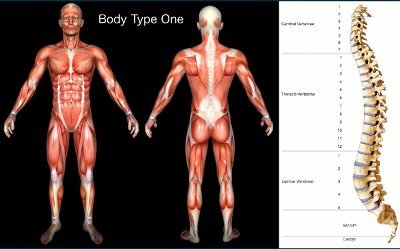
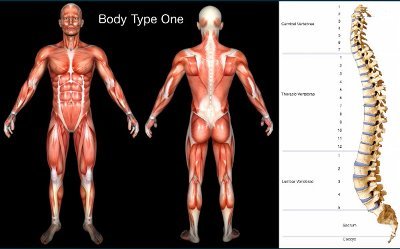
    Moreover, the copious fake filtered and Photoshopped body images and widespread disinformation and misinformation on social media only make the problem worse. Body Type Science helps reduce confusion and nonsense by allowing the individual to scientifically understand, determine, and identify their real body type. As a comprehensive solution, Body Type Science helps you accept your genetic body type, therefore allowing you to make healthy science-based diet, exercise, and lifestyle choices that encourage improved mental, emotional, and physical well-being in the short and long term.

    Fellow One Research’s cutting-edge science-based tools can help, including the online Scientific Body Type Quiz and Scientific Weight Loss Programs.  Listen to this interesting and informative The FemiNinja Podcast episode on Apple Podcasts.


    The Four Body Types - Comparing BT1, BT2, BT3, and BT4
    Which of The Four Body Types are You?


    Browse Celebrities


    Browse: All Posts, Athletic Body Type, Body Type Science, Cellulite, Council Advice, Diet, Diet Details, Exercise, Fat, Featured Article, Fellow One Research, Good Bacteria, Gut Bacteria, Gut Feeling, Gut Flora, Gut Microbiome, Gut-Brain Axis, Health, How to Eat Right, How to Gain Weight Naturally, How to Gain Weight Safely, How to Live a Healthy Life, How to Live Healthy, How to Lose Weight, How to Lose Weight Naturally, How To Lose Weight Safely, How to Naturally Lose Weight, How to Safely Lose Weight, How to Successfully Lose Weight, Immunity, Learn About Body Type Four, Learn About Body Type One, Learn About Body Type Three, Learn About Body Type Two, Lifestyle, Metabolism, Muscle Mass, Muscles, Normal Weight Obesity, Podcast, Podcast (Guest), Posture, Science, Scientific Body Type Quiz, Scientific Research, Scientific Weight Loss, Scientist, Self-Help, Self-Improvement, Skinny Fat, Spiritual, Spiritual Scientist, The Four Body Types, Thin Fat, Vertebrae, Weight Gain, Weight Loss, Weight Management, What Is My Body Type

    Podcast Guest: The Podcast by KevinMD with Dr. Kevin Pho – Skinny Fat (Normal Weight Obesity)

    Fellow One Research lead scientific researcher, Marc Nelson, appeared on The Podcast by KevinMD with host Dr. Kevin Pho to discuss skinny fat (normal weight obesity). Only being loosely recognized and somewhat accepted by mainstream science and medical doctors in the last decade or so, normal weight obesity (skinny fat) is defined as having too much fat on your body when within your safe BMI weight range (18.5 to 24.99).

    Regular obesity — a disease — means having too much body fat which takes you outside your safe BMI weight range. The conversation focused on better understanding the difference between regular fat tissue (white/yellow body fat/adipose tissue) and skinny fat tissue (thin fat, cellulite). Things began by first clarifying the current mainstream science and medical doctor’s body standards.

    Current Mainstream Science/Medicine Body Standards 


    When you go to see your licensed medical doctor for your regular checkup, you, like every human being, are being judged by:

    Standard #1: Standard Body Type One (BT1)

    Found in any scientifically approved human body anatomy resource. Standard #1 is not accurate because it no less than fails to recognize that it is a scientific/genetic fact that any part of the human body can be underdeveloped to whatever degree. In particular, a lack of genetic default muscle tissue that goes hand-in-hand with genetic skinny fat tissue. Everyone is not born in a Standard BT1.Kevin MD Podcast - Standard Scientific Human Body Anatomy Book Body Type One BT1

    Standard #2: Body Mass Index (BMI)

    Standard #2 is not accurate because it no less than fails to take into account genetic skinny fat tissue where genetic default muscle tissue should be, but is not. For countless people globally, even when they are within their safe BMI weight range they still somehow have too much body fat, which directly contradicts and violates the Standard BMI definition (once within safe BMI, by definition you no longer have any excess body fat). Just as the BMI fails to realize the possibility of excess muscle mass — genetic and/or added via exercise — that can put one into the overweight or obese column of their BMI weight scale but they are not overweight or obese.

    Standard #3: Basal Metabolic Rate (BMR)

    Standard #3 is also inaccurate as it no less than fails to calculate skinny fat tissue in the Standard Mifflin St Jeor Equation (BMR) and Harris-Benedict Equation for activity (TDEE). Science recognizes that one pound of muscle tissue burns six calories per day but one pound of regular fat and/or skinny fat tissue only burns two to three calories per day. Which directly and negatively affects metabolism, at least. If you have genetic skinny fat tissue on your body where you should have genetic muscle tissue yet are within safe BMI, you are likely eating too many calories daily following your standard BMR/TDEE calculations.

    The Podcast by KevinMD – Diagnosing Skinny Fat  (Normal Weight Obesity)


    The discussion shifted to how there is currently no real means for doctors to diagnose normal weight obesity (skinny fat). Since the BMI became the standard in the mid-1980s, very little if anything has changed in terms of the current body standards and medical care, in general. Fellow One Research’s Body Type Science (The Four Body Types) research is working on changing things to improve the accuracy of the currently accepted body standards so doctors have more The Podcast by KevinMD with Host Dr. Kevin Phoaccurate ways to make the appropriate diagnosis, as needed.

    Having the proper means to make the necessary diagnosis will improve healthcare and aggregate human health, in general. This includes helping mitigate the worsening worldwide obesity epidemic. Moreover, wrangling the widespread, unrealistic, inaccurate physical body standards and expectations placed on the average person by mainstream scientists and doctors, social media, the media, and society will improve no less than declining emotional and mental health, especially among young people.

    Body Type Science Research Tools

    The Body Type Science research helps you understand your genetic scientific body type (composition and shape) and metabolism, allowing you to make better, healthier science-based diet, exercise, and lifestyle choices to improve mental, emotional, and physical well-being in the short and long term. Fellow One Research’s cutting-edge science-based tools include the online Scientific Body Type Quiz and Scientific Health Quizzes.  Listen to this educational and informative The Podcast by KevinMD episode on Apple Podcasts.


    The Four Body Types - Comparing BT1, BT2, BT3, and BT4
    What is your unique genetic body composition?


    Browse Celebrities


    Browse: All Posts, Body Type Science, Cellulite, Council Advice, Diet, Diet Details, Exercise, Fat, Featured Article, Fellow One Research, Health, How to Eat Right, How to Gain Weight Naturally, How to Gain Weight Safely, How to Live a Healthy Life, How to Live Healthy, How to Lose Weight, How to Lose Weight Naturally, How To Lose Weight Safely, How to Naturally Lose Weight, How to Safely Lose Weight, How to Successfully Lose Weight, Learn About Body Type Four, Learn About Body Type One, Learn About Body Type Three, Learn About Body Type Two, Lifestyle, Metabolism, Muscle Mass, Muscles, Normal Weight Obesity, Podcast, Podcast (Guest), Posture, Science, Scientific Body Type Quiz, Scientific Research, Scientific Weight Loss, Scientist, Self-Help, Self-Improvement, Skinny Fat, The Four Body Types, Thin Fat, Vertebrae, Weight Gain, Weight Loss, Weight Management, What Is My Body Type

    Podcast Guest: The Monthly Social Podcast, Guido Piraino – Body Type Science & Health

    Fellow One Research lead scientific researcher, Marc Nelson, appeared on The Monthly Social Podcast with host Guido Piraino to discuss Body Type Science (The Four Body Types) and health.  Most people do not understand why there are so many different human body types or how body shape affects health. Just as most people do not realize that the popular endomorph, ectomorph, and mesomorph somatotype body types are unscientific, arbitrary, subjective, baseless nonsense, including the hormone body types as well as the Kibbe, triangle, 10 body types, etc.

    The conversation focused on better understanding health by first clarifying the current mainstream science and medical doctor’s body type standards, which are:

    1. Standard #1: Standard Scientific Human Body Anatomy Book Body Type One (BT1) found in any scientifically approved human body anatomy book. This first standard is inaccurate because it does not recognize that it is a scientific/genetic fact that any part of the human body can be underdeveloped to whatever degree, nor does it give credence to any form of skinny fat.The Monthly Social Podcast, Guido Piraino - Body Type Science, Standard Scientific Human Body Anatomy Body Type One (BT1)
    2. Standard #2: Body Mass Index (BMI) – It is inaccurate because it does not take into account skinny fat or the possibility of excess muscle mass, which can put one into the overweight or obese column of their BMI weight scale but they are not overweight or obese.
    3. Standard #3: Basal Metabolic Rate (BMR)It is not accurate as it does not calculate skinny fat into the Standard Mifflin St Jeor Equation and Harris-Benedict Equation for activity, yet science recognizes that one pound of muscle mass burns six calories daily but one pound of fat/skinny fat only burns two to three calories daily, which directly, negatively affects metabolism.

    The Four Body Types – Body Type Science & Health


    The Four Body Types definitions were then explained. A direct correlation with genetics/DNA is made, especially vertebrae (posture) The Monthly Social Podcast, Guido Piraino - Comparing The Four Body Typesand muscles/muscle mass development (or lack thereof) compared to skinny fat and fat. For many people worldwide, no matter how diligent they are with their diet, exercise, metabolism (BMR), BMI, and lifestyle, their genetics play a key role in their body type and shape, including gut flora/gut microbiome health.

    In terms of diet, the most current science shows that a calorie is not a calorie, that food quality matters (especially low Glycemic Index/GI foods), and that a low-carb diet with a bullseye of 37 grams of carbs per day is a very effective way to lose weight for many people. This is particularly true for people who have failed to successfully lose the desired weight with any other diet they have followed. The importance of proper exercise to positively influence metabolism as well as healthy lifestyle choices, particularly stress and sleep, are also addressed.

    The Monthly Social Podcast, Guido Piraino – Modern Body Type Science Standards

    The discussion shifted to the widespread, unrealistic, inaccurate physical body type standards and expectations placed on the Guido Piraino Podcast - Body Type Scienceaverage person by mainstream scientists and doctors, social media, the media, and society in general. How can anyone be happy in a Body Type Two, Three, or Four when such unfair physical standards and expectations are the cultural norm? Unfair standards that encourage unhealthy diet, exercise, and lifestyle choices, all of which are negatively reflected in declining physical (obesity epidemic), emotional, and mental health globally, especially among young people.

    Social Media Misinformation & Disinformation

    Furthermore, the copious Photoshopped and fake filtered body images and all-too-common disinformation and misinformation on social media only make the problem worse. Body Type Science helps mitigate confusion and nonsense by allowing the individual to scientifically understand, determine, and identify their real body type. As a comprehensive solution, Body Type Science helps you accept your genetic body type, thus allowing you to make healthy science-based diet, exercise, and lifestyle choices that encourage improved mental, emotional, and physical well-being in the short and long term.

    Fellow One Research’s current science-based tools can help, including the online Scientific Body Type Quiz and Scientific Weight Loss Programs.  Listen to this informative and educational The Monthly Social Podcast episode on Spotify, Apple Podcasts, and Google Podcasts.


    The Four Body Types - Comparing BT1, BT2, BT3, and BT4
    Which of The Four Body Types are You?


    Browse Celebrities


    Browse: All Posts, Athletic Body Type, Body Type Science, Cellulite, Council Advice, Diet, Diet Details, Exercise, Fat, Featured Article, Fellow One Research, Good Bacteria, Gut Bacteria, Gut Feeling, Gut Flora, Gut Microbiome, Gut-Brain Axis, Health, How to Eat Right, How to Gain Weight Naturally, How to Gain Weight Safely, How to Live a Healthy Life, How to Live Healthy, How to Lose Weight, How to Lose Weight Naturally, How To Lose Weight Safely, How to Naturally Lose Weight, How to Safely Lose Weight, How to Successfully Lose Weight, Immunity, Learn About Body Type Four, Learn About Body Type One, Learn About Body Type Three, Learn About Body Type Two, Lifestyle, Metabolism, Muscle Mass, Muscles, Normal Weight Obesity, Podcast, Podcast (Guest), Posture, Science, Scientific Body Type Quiz, Scientific Research, Scientific Weight Loss, Scientist, Self-Help, Self-Improvement, Skinny Fat, Spiritual, Spiritual Scientist, The Four Body Types, Thin Fat, Vertebrae, Weight Gain, Weight Loss, Weight Management, What Is My Body Type

    Insights from Gnosis: Gut Flora (Microbiome), Good Bacteria, and Body Type

    Gut Flora (Microbiome) & Good Bacteria – Healthy Diet, Exercise, & Lifestyle

    As the scientific evidence and facts about gut flora and good bacteria continue to roll in, it is becoming clear that what we eat, the quality Diet & Healthy Food - Gut Flora (Microbiome), Good Bacteriaand quantity of foods in our diet, are of utmost importance. Keep refined sugar and processed, junk, and fast foods as well as poor quality fats to a minimum. Maximize your intake of whole vegetables, fruits, and lean, quality protein.

    Organic is best if within your means. Moderation is the rule. Improve gut flora and good bacteria with probiotics. Foods like yogurt, kefir, kombucha, sauerkraut, pickles, miso, tempeh, kimchi, sourdough bread, and some cheeses are solid choices.

    Genetics carries substantial clout when it comes to which diet is best for your specific body type. Figuring out which diet is optimal for your unique body type takes time and patience. But, if done right, it will pay off when it comes to digestion, weight management, weight loss, obesity (childhood & adult), immune response, and health as a whole.

    You can review the list of different possible diets here (towards the bottom of the page). If in doubt, science recommends the Blue Zone Meditteranean Diet. Moreover, getting proper weekly exercise and making consistent healthy lifestyle choices will further increase the health of your flora/gut microbiome.

    How Body Type Affects The Gut Flora, Enteric Brain, & Gut Feeling

    Muscle is one of the most valuable resources in terms of being the armor of the human body. Gastrointestinal imbalance has become more mainstream in recent years, including discussion relative Good Bacteria and Gut Florato irritable bowel syndrome (IBS), Crohn’s Disease, and other such digestive unpleasantness. The scientific evidence has grown to suggest that gut flora and good bacteria are crucial players.

    The Four Body Types research is starting to show that a lack of muscle/mass in the abdominal and surrounding areas, no less, also has profound negative effects on the enteric nervous system, gut flora, and gut feeling. Genetically, the more skinny fat (cellulite, thin fat, loose skin, saggy skin, crepey skin, normal weight obesity) and fat that you have on your body, the less muscles/muscle mass you have. Your metabolism as well as your ability to hold the energy and stand the heat in day-to-day life directly correlates to your body type, particularly muscle/mass in relation to skinny fat.

    As our Body Type Science research continues to expand, it will be interesting to see how much a lack of muscle/mass especially affects Body Type Two (BT2), Body Type Three (BT3), and Body Type Four (BT4) people. And what advantages a Body Type One (BT1) may have, if any. Stay tuned.


    The Four Body Types - Comparing BT1, BT2, BT3, and BT4


    Browse Celebrities


    Browse: Adult Obesity, All Posts, Best Daily Life Advice, Brain, Cellulite, Childhood Obesity, Council Advice, Diet, Enteric Brain, Exercise, Fat, Featured Article, Fellow One Research, Fluid Intelligence, Good Bacteria, Gut Bacteria, Gut Feeling, Gut Flora, Gut Microbiome, Gut-Brain Axis, Health, How to Eat Right, How to Gain Weight Naturally, How to Gain Weight Safely, How to Live a Healthy Life, How to Live Healthy, How to Lose Weight, How to Lose Weight Naturally, How To Lose Weight Safely, How to Naturally Lose Weight, How to Safely Lose Weight, How to Successfully Lose Weight, Human Energy System, Immune System, Immunity, Insights from Gnosis, Learn About Body Type Four, Learn About Body Type One, Learn About Body Type Three, Learn About Body Type Two, Lifestyle, Metabolism, Muscle Mass, Muscles, Normal Weight Obesity, Posture, Science, Scientific Body Type Quiz, Scientific Research, Self-Help, Self-Improvement, Skinny Fat, Spinal Extension, Stress, Thin Fat, Trending News, Vertebrae, Weight Gain, Weight Loss, Weight Management, What Is My Body Type

    Podcast Guest: Infusion Health Podcast – Body Type Science, BMI & BMR

    Fellow One Research lead scientific researcher, Marc Nelson, appeared on the Infusion Health Podcast with hosts Rachel and Cris to discuss Body Type Science (The Four Body Types) including BMI and BMR.  Most people do not realize that the popular endomorph, ectomorph, and mesomorph somatotype body types are unscientific, arbitrary, subjective, baseless nonsense, just like the hormone body types as well as the Kibbe, triangle, 10 body types, etc. The conversation focused on clarifying the current mainstream science and medical doctor’s body type standards, which are:

    1. Standard Scientific Human Body Anatomy Book Body Type One (BT1) found in any scientifically approved human body anatomy book. This first standard is inaccurate because it does not recognize that it is a scientific/genetic fact that any part of the human body can be underdeveloped to whatever degree, nor does it give credence to any form of skinny fat.Standard Scientific Human Body Anatomy Book Body Type One (BT1)
    2. Body Mass Index (BMI) is the second standard. It is inaccurate because it does not take into account skinny fat or the possibility of excess muscle mass, which can put one into the overweight or obese column of their BMI weight scale but they are not overweight or obese.
    3. Basal Metabolic Rate (BMR) is the third standard. It is not accurate as it does not calculate skinny fat into the Standard Mifflin St Jeor Equation and Harris-Benedict Equation for activity, yet science recognizes that one pound of muscle mass burns six calories daily but one pound of fat/skinny fat only burns two to three calories daily, which directly, negatively affects metabolism.

    The Four Body Types – BMI, BMR, Genetics, Vertebrae, Muscle, Skinny Fat, & Fat


    The Four Body Types definitions were then explained. A direct correlation is made to genetics, especially vertebrae/posture Project Fitness Podcast with Chris Fudge - Comparing The Four Body Typesand muscles/muscle mass development (or lack thereof) compared to skinny fat and fat. For many people globally, no matter how diligent they are with their diet, exercise, metabolism (BMR), BMI, and lifestyle, their genetics play a key role in their body type and shape.

    In terms of diet, the most recent science shows that a calorie is not a calorie, that food quality matters (especially low Glycemic Index/GI foods), and that a low-carb diet with a bullseye of 37 grams of carbs per day is a very effective way to lose weight for many people. This is especially true for people who have failed to successfully lose the desired weight with any other diet they have followed. The importance of proper exercise to positively influence metabolism as well as healthy lifestyle choices, particularly sleep and stress, are also addressed.

    Infusion Health Podcast – Modern Body Type Science Standards

    The discussion shifted to the common, unrealistic, inaccurate physical body type standards and expectations placed on the average person by mainstream scientists and doctors, social media, the media, and society in general. How can anyone be happy in a Body Type Two, Three, or Four when such unfair physical standards and expectations are the cultural norm? Infusion Health Podcast - Body Type Science, BMI, and BMRUnfair standards that encourage unhealthy diet, exercise, and lifestyle choices, all of which are negatively reflected in declining physical (obesity epidemic), emotional, and mental health worldwide, especially among young people.

    All the fake filtered and Photoshopped body images and widespread misinformation and disinformation on social media only make the problem worse. Body Type Science helps mitigate the confusion and nonsense by allowing the individual to scientifically understand, determine, and identify their real body type. As a comprehensive solution, Body Type Science helps you accept your genetic body type as it is thus allowing you to make healthy science-based diet, exercise, and lifestyle choices that encourage improved mental, emotional, and physical well-being in the short and long term.

    Fellow One Research’s current science-based tools can help, including the online Scientific Body Type Quiz and Scientific Weight Loss Programs.  Listen to this informative and educational Infusion Health Podcast episode on Spotify, Apple Podcasts, and Google Podcasts.


    The Four Body Types - Comparing BT1, BT2, BT3, and BT4
    Which of The Four Body Types are You?


    Browse Celebrities


    Browse: All Posts, Athletic Body Type, Body Type Science, Cellulite, Council Advice, Diet, Diet Details, Exercise, Fat, Featured Article, Fellow One Research, Gut Bacteria, Gut Feeling, Gut-Brain Axis, Health, How to Eat Right, How to Gain Weight Naturally, How to Gain Weight Safely, How to Live a Healthy Life, How to Live Healthy, How to Lose Weight, How to Lose Weight Naturally, How To Lose Weight Safely, How to Naturally Lose Weight, How to Safely Lose Weight, How to Successfully Lose Weight, Immunity, Learn About Body Type Four, Learn About Body Type One, Learn About Body Type Three, Learn About Body Type Two, Lifestyle, Metabolism, Muscle Mass, Muscles, Normal Weight Obesity, Podcast, Podcast (Guest), Posture, Science, Scientific Body Type Quiz, Scientific Research, Scientific Weight Loss, Scientist, Self-Help, Self-Improvement, Skinny Fat, Spiritual, Spiritual Scientist, The Four Body Types, Thin Fat, Vertebrae, Weight Gain, Weight Loss, Weight Management, What Is My Body Type